Description
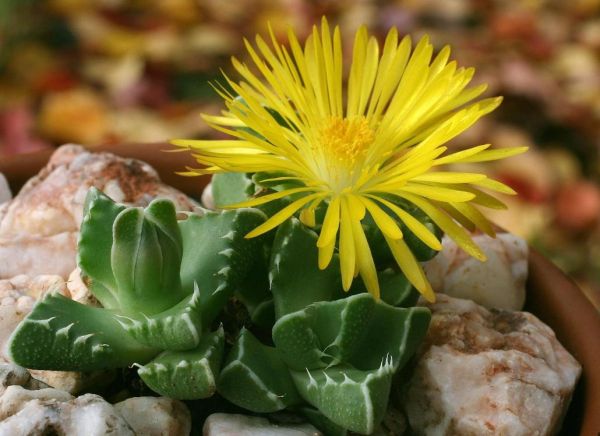
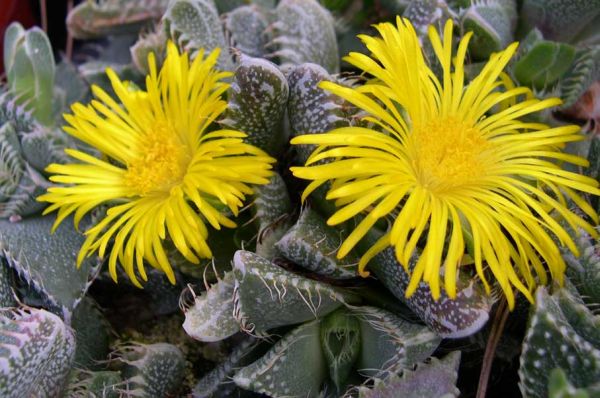
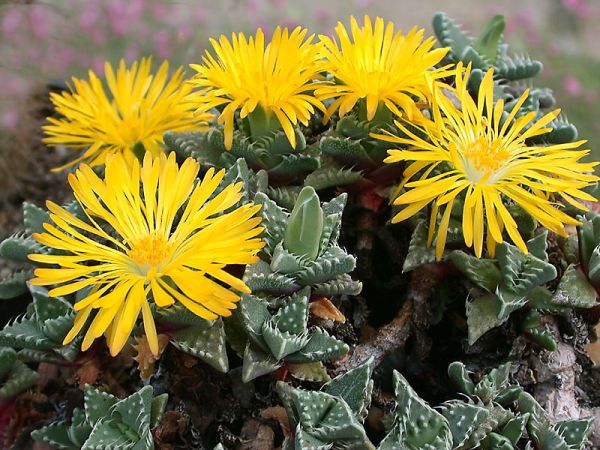
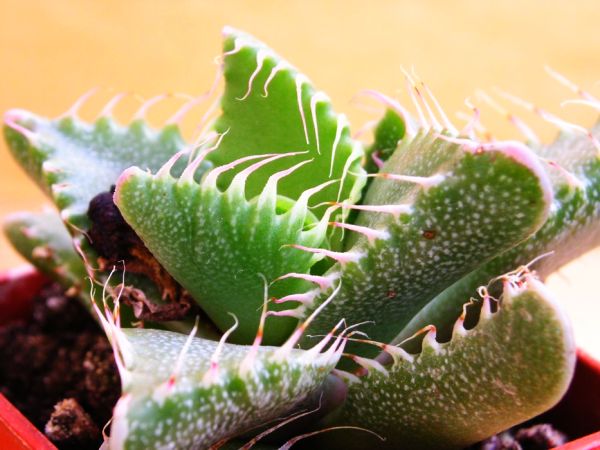
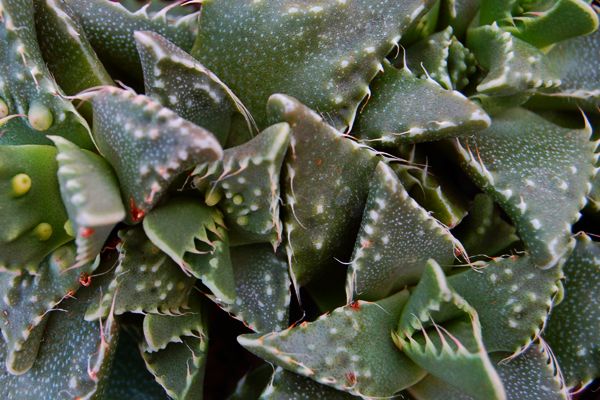
Faucaria comes from the deserts and semi-deserts of South Africa. It was brought to Europe as early as 1790. It is a small, carpet-forming plant. It has fleshy leaves that are flat on top and have a triangular keel underneath. Each pair of leaves is fused at the base. The leaf edges are lined with tooth-like projections that make the plant look like the open jaws of a predator. At the end of August huge yellow flowers appear, which open only when the sun shines. They do not last very long.
Requirements
Like other succulents, Faucaria has a growing period and a rest period. The relatively short growing period falls in summer. During this time the plant needs a great deal of light and warmth and, most importantly, enough water and fresh air – but it must never stand in a draught. Fresh air is also essential in winter, when the plant should be kept in a cool (5°C), dry place. Do not water it then – in damp conditions Faucaria rots.
Propagation
Propagate from cuttings in April. The cut surface of the cutting should be dry. Then plant the cutting in a mix of equal parts ordinary soil and sand. At first water very sparingly so that the soil is not too wet and the fine roots do not rot. Bottom heat speeds up root formation. Remember that until the cutting starts to grow, it must be kept in the shade.
Care
In summer, during the short growing period, water often; during the rest period, do not water at all. Feed with a liquid cactus fertiliser only before flowering. The plant is not pruned. Repot only when the pot is clearly too small – roughly every three years. The compost must be porous with good drainage.
When plants get sick
Brown patches on the lower part of the stem – an obvious sign of rot; unfortunately the base of the plant cannot be cured. While it is still possible, take cuttings from this plant or separate a healthy part.
Before you buy
The plant should sit firmly in its pot. Check that it is not rotting.
Average lifespan: it can live a very long time.
Difficulty of care: growing it is not entirely trouble-free.