Description
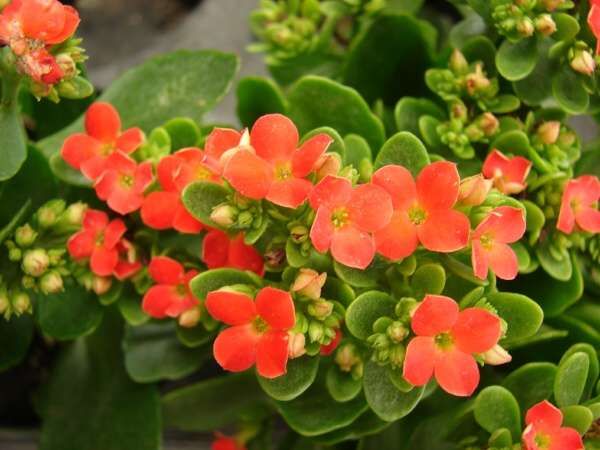
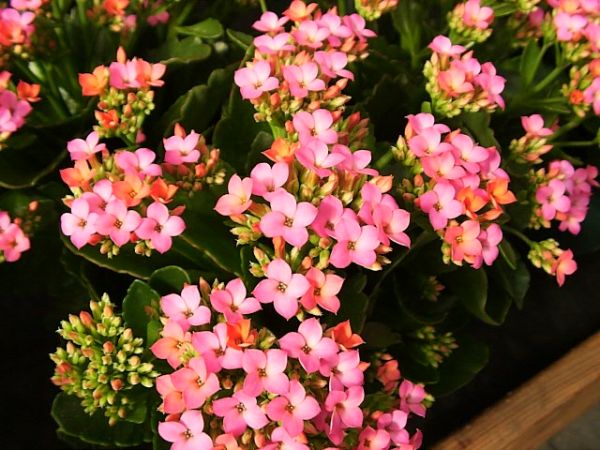
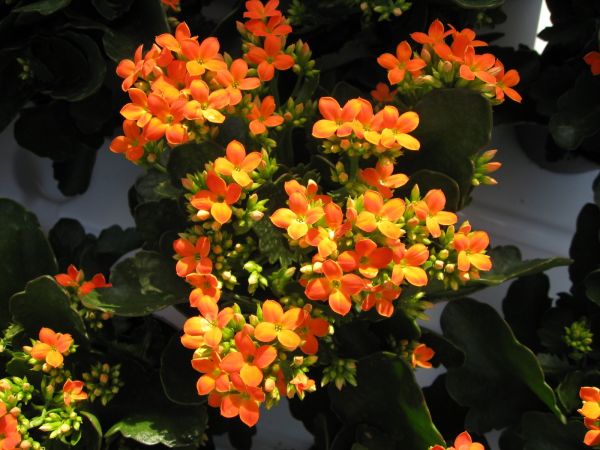
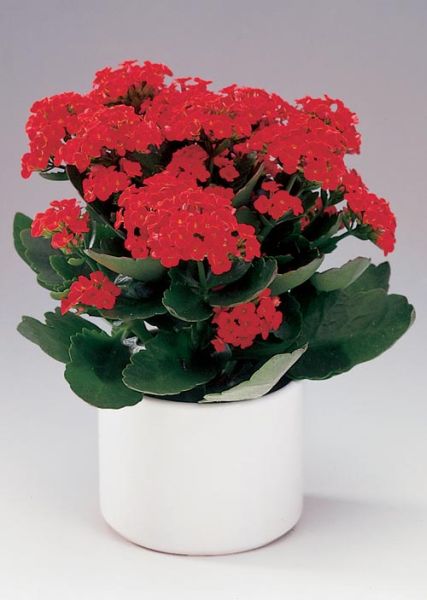
Kalanchoe is one of the most popular pot plants; thanks to its abundant flowering – also in winter – and decorative leaves, it never goes out of fashion. It belongs to the stonecrop family and comes from Madagascar, where Kalanchoe blossfeldiana, the ancestor of today's hybrids, flowers profusely in dry areas. The most sought-after species of the genus are those that do very well in pots. They have long-lasting leaves and flower heads resembling corymbs. The colour range is now quite wide, including red, white, pink and yellow. Breeding has also produced forms with fuller flowers, as well as miniatures. Kalanchoe blossfeldiana grows up to 25 cm and, thanks to controlled cultivation, flowers almost all year round. Another very unusual form is K. tomentosa, the panda plant, with very decorative, lance-shaped, thick, fleshy, felty leaves whose colour depends on the position: whitish in shade and dark brown in full sun. The pot form grows to 10–20 cm.
Requirements
Kalanchoe likes bright positions, although it adapts well to the conditions. It tolerates cooler, north-facing windows without affecting how profusely it flowers. The optimum temperature is 10–23°C, and it should not fall below 15°C during flowering.
Propagation
Kalanchoe is best propagated from tip cuttings rooted in May and June in a mix of sand and clay, using a rooting hormone. Young shoots that appear after the old flower heads have been removed are suitable as cuttings.
Care
Kalanchoe is a short-day plant, which means it needs light for less than 10 hours a day to flower again. To provide these conditions, you can cover it with a cardboard box. The darkening treatment should last about 4–8 weeks, for 14 hours a day. Without it the plant will decline and end up fit only for the bin. To prolong flowering, cut off faded flowers together with their stalks. The fact that Kalanchoe is a succulent shows that watering must not be heavy. Water when the surface of the compost has dried, usually once a week, and even more sparingly in winter. Use fairly soft water. Feed once every two weeks, and repot in spring every other year, using a free-draining, humus-rich compost with added sand.
Before you buy
When buying a Kalanchoe, look carefully at the flowers – only half of them should be fully coloured and open. If some flowers have already faded, the plant is past its best. Also check that the leaves have no spots with a powdery mildew coating.