Description
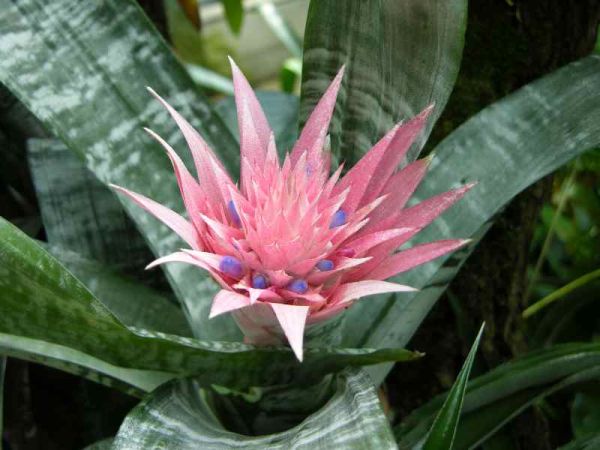
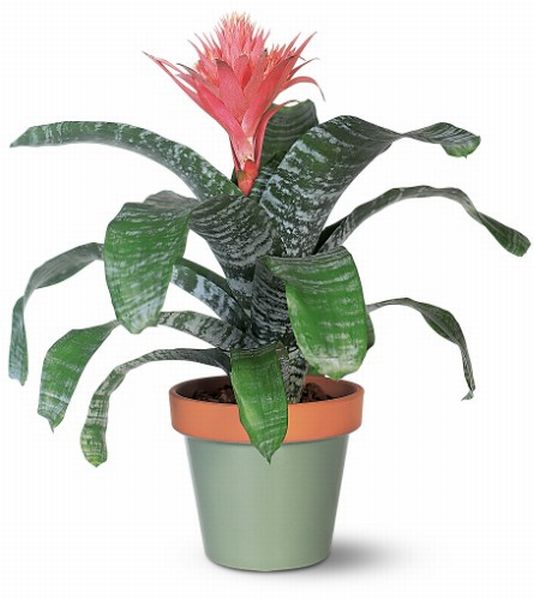
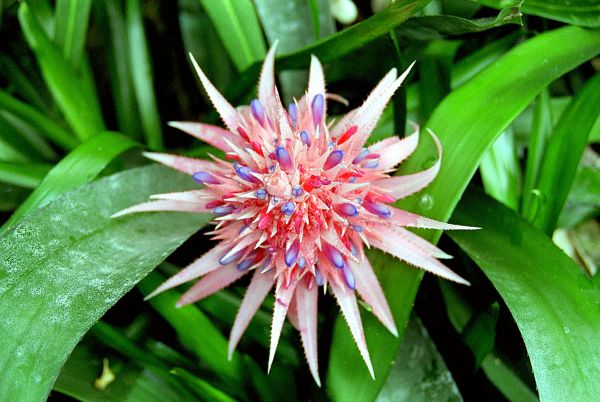
The urn plant comes from South America, where it was discovered in 1826. Its channelled leaves, gathered in a funnel-shaped rosette, are green and covered with a white bloom that forms transverse bands. They make a beautiful contrast with the pink flower spike growing from the centre of the rosette. The true flowers, which are violet, are clustered at the top of the inflorescence between pink bracts. There are rare varieties with plain green or marbled yellow-green leaves. Like other bromeliads, this Aechmea flowers only once, producing small flowers successively in the inflorescence, which last for some time.
Requirements
Aechmea is a very tolerant plant. It copes well with direct sun but also with diffused light. Room temperature above 12°C and below 27°C is enough for growth. It needs fairly moist soil.
Propagation
At home Aechmea is propagated from young offset rosettes, which are separated and potted up after the mother plant dies. Be sure to wait until the old rosette has completely dried.
Care
Water twice a week. There should also be about 2.5 cm of water in the funnel of the rosette, which should be changed every 3 weeks – rainwater is best.
After flowering, the rosette gradually dies, and at least two young rosettes form at its base. Finally, the dead mother plant is removed and the young rosettes are separated and planted in individual pots.
Before you buy
When buying, choose a plant that is in flower, but with the flower spike only just emerging from the centre of the rosette. A well-grown rosette can be up to 60 cm across with leaves 30 cm long. Check that the base of the rosette and the flower spike show no signs of rot.