Description
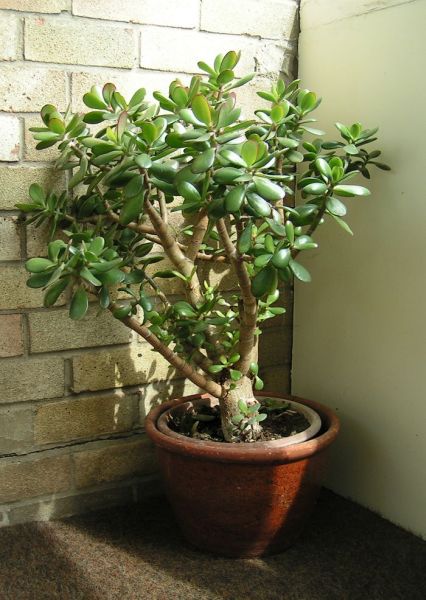
Crassula ovata – the jade plant, also called the money tree or friendship tree – is a species of the stonecrop family. It is the most popular member of its genus in cultivation and comes from South Africa.
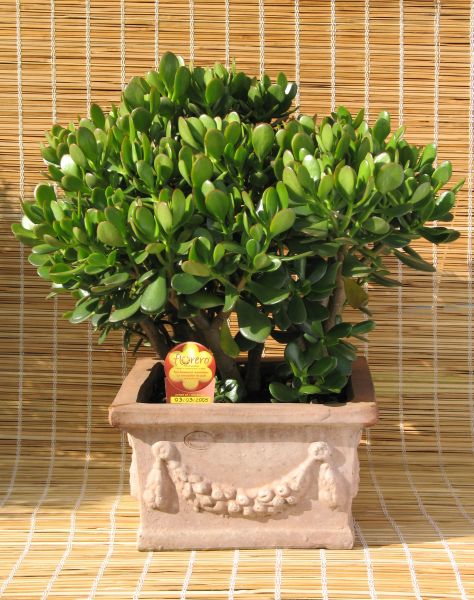
In the wild this perennial reaches up to 4 m, while in a pot it usually grows to about 1 m. It grows slowly but steadily, lengthening its shoots by a few centimetres a year.
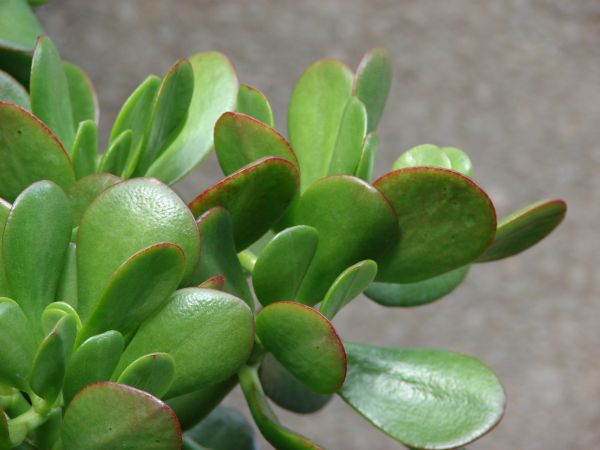
The leaves are fleshy, store water and are arranged in opposite pairs. They are glossy, egg-shaped and bright green, sometimes with red edges or undersides.
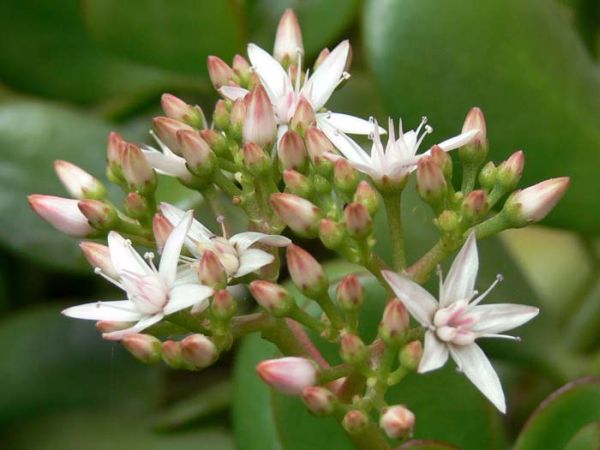
The flowers are tiny, white or pink and five-petalled. They appear at the shoot tips only on older plants, in our climate in autumn and winter – and in cultivation only on plants grown in a well-lit place.
Cultivars with distinctive leaf shapes or colours are grown. The most common are 'Gollum' or 'Hobbit', with tubular leaves hollowed at the tips; varieties with coloured leaves, such as 'Tricolor', are less common.
It is a popular houseplant – striking yet undemanding. It is also ideal for fans of the Far Eastern art of dwarfing trees and shrubs: even a small cutting looks like a bonsai.
Requirements
It prefers sandy-loam soils. It tolerates dry air well. It likes light, but if it stands in strong summer sun, the leaves turn slightly yellow and wrinkle; in such cases shade the plant. Well-lit windowsills are a good spot. It grows best at 20–22°C but also tolerates temperatures a few degrees higher or lower. A drop of about 10°C at night is good for the plant, as it resembles the natural conditions in Africa.
Propagation
The jade plant is propagated from softwood cuttings taken in spring or summer. The cuttings can be put in a container of water and planted in a pot as soon as roots appear.
Care
In summer it is good to put the plant out on the balcony, or even plunge it, pot and all, in the garden. In winter move it to a cooler, bright room. Do not place it near radiators. It needs a free-draining compost with plenty of coarse sand enriched with fertile leaf mould, without peat. There must be a thick drainage layer at the bottom of the pot.
Water the plant generously, but wait until the soil has dried completely before watering again. Overwatering is the main cause of failure. Feed it once or twice a year – in spring and early summer. Between feeds you can sprinkle dried cow manure on the surface of the soil, which results in healthy, nicely coloured leaves. Repot only when the roots no longer fit in the pot; this can be done at any time of year. Older plants are left alone and not repotted at all – it is enough to add a little fresh, fertile compost to the top of the soil from time to time.