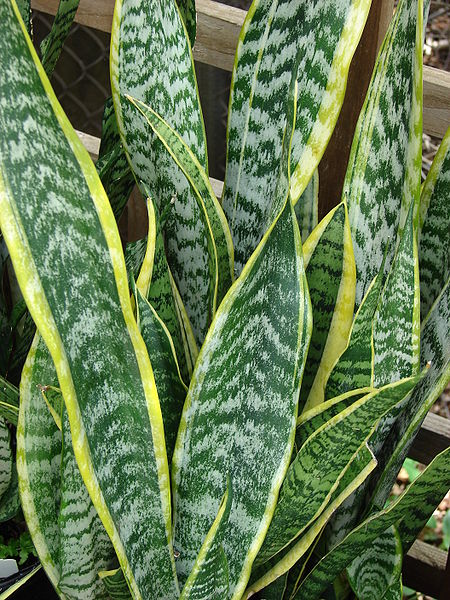
Description
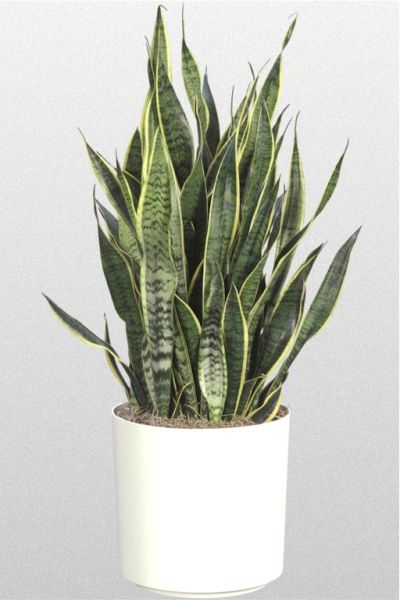
Sansevieria trifasciata (snake plant, mother-in-law's tongue) is a leaf succulent – it stores water in its fleshy leaves. It comes from western equatorial Africa and has been grown as a houseplant for several centuries. It is named after the Italian aristocrat Raimondo di Sangro, Prince of Sansevero (1710–1771), a plant lover who was the first to bring sansevieria from Africa to Naples.
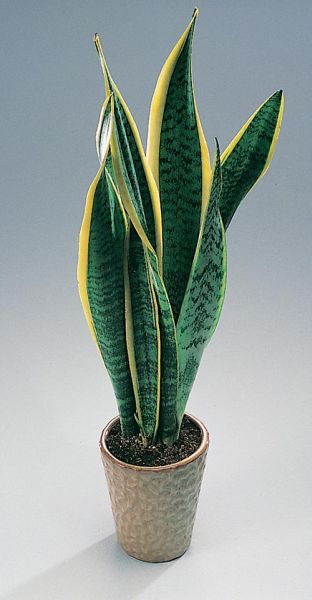
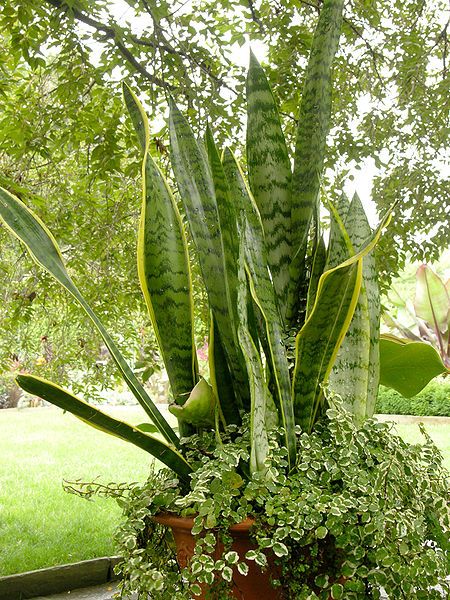
The plant grows up to 100–120 cm tall, though usually reaches 40–80 cm. Dwarf varieties up to 30 cm tall are also sold. The long, sharply pointed, upright green leaves, 5–6 cm wide, grow straight from the compost, with 2–3 new ones appearing each year. They have yellowish or cream edges and darker, irregular cross-bands.
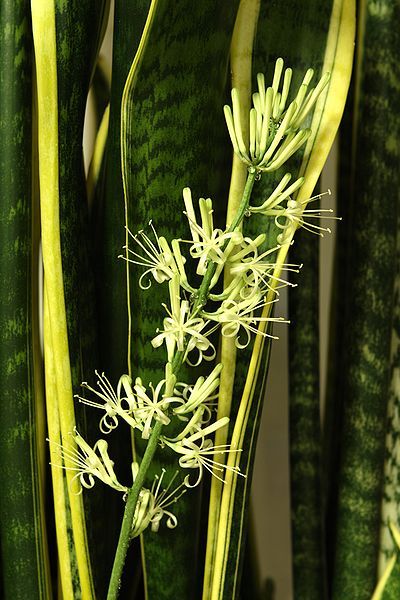
Sansevieria usually flowers in early summer. Flower spikes 30–70 cm tall, made of small, delicately scented, pale yellow-green flowers, grow straight from the compost beside the leaves. Remember to remove them after flowering.
Requirements
Sansevieria is long-lived and very resistant to adverse conditions: drought, large temperature fluctuations and strong sun. The only thing it dislikes is overwatering.
Propagation
Sansevieria is propagated by cuttings, best in March. Cut a leaf across into 5–6 cm sections and leave them to dry, then dip their lower ends in rooting hormone and insert them in a mix of peat and sand. Take care not to put them in upside down. Cover the container with film and place it in a bright spot at about 20°C. When the cuttings have 2–3 new leaves, carefully separate them from the old leaf section and pot them up. New plants grown from leaf cuttings do not have coloured edges.
Sansevieria can also be divided, ideally in late summer, by separating young offsets and carefully pulling the root ball apart.
Care
Sansevieria grows well in full sun, partial shade and even shade. In summer provide 21–24°C, and 18°C in winter. The plant tolerates temperatures below 10°C, but only in dry homes – in cool, damp ones it may rot. The cooler it is, the less you should water. Always take care not to overwater and remove excess water. In summer water once every 1–2 weeks, in winter even every 3 weeks. Do not mist or use leaf shine – just wipe the leaves with a damp cloth. Feed only in summer, every 3 weeks, with a liquid compound fertiliser. Repot younger plants every 2 years and older ones every 3 years, remembering to put a 2–3 cm drainage layer at the bottom of the pot.
When plants get sick
Take care not to overwater, as the rhizome is very prone to rot.
Before you buy
Check that the leaves are firm and free of pests.
Average lifespan: – Can live for a very long time.
Difficulty of care: – Easy to grow.