Description
Plectranthus comes from tropical regions – according to some sources from Fiji, New Caledonia and Australia, according to others from the Indian subcontinent. It is grown as an ornamental plant, in Poland mainly as a houseplant.
The Latin genus name Plectranthus refers to the structure of the flowers, which resemble a spur.
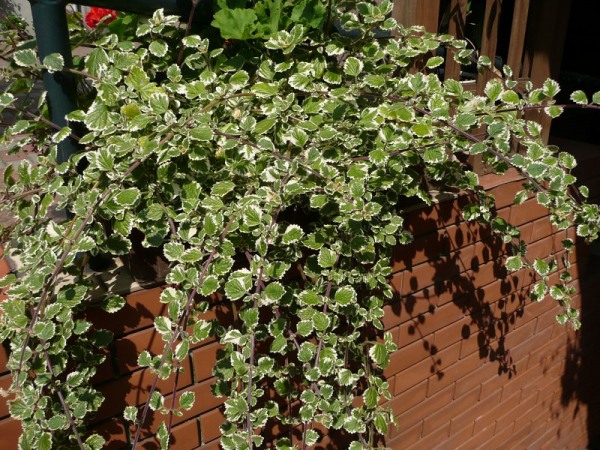
The fairly thick, finely hairy, purple-flushed stems at first grow upwards and then trail, reaching up to 100 cm in length.
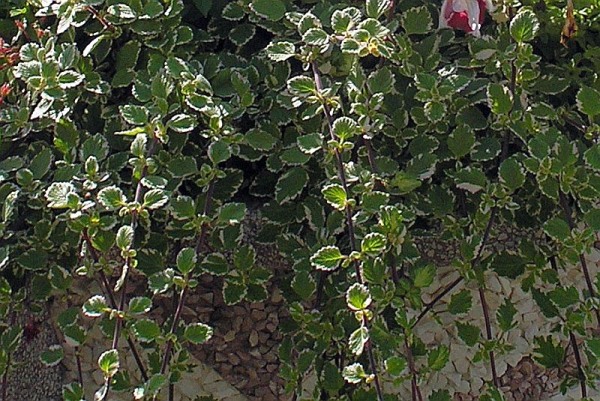
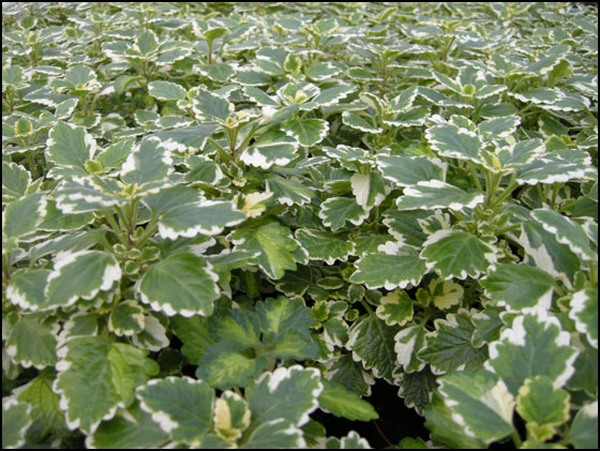
The leaves are simple, short-stalked, broadly egg-shaped with scalloped edges, finely hairy and light green. In the most commonly grown variety, 'Marginatus', they have white margins.
The flowers are two-lipped, typical of the mint family, pale violet or white, growing in whorls at the tips of the shoots and forming racemes 15–20 cm long. They are not very ornamental.
It is a perennial. It flowers from summer to autumn, but here it rarely sets seed. The whole plant gives off an unpleasant, fairly strong smell similar to ground ivy. The smell repels moths and mosquitoes, hence its popular Polish name, "komarzyca" (mosquito plant). It spreads strongly, forming a dense mat. The plant is long-lived but needs rejuvenating every 3–4 years, as older specimens become unattractive.
It is a good ground-cover plant, valued for its leaves and habit. As it is not frost-hardy, however, it can only be grown outdoors as an annual. It is usually grown in pots and used to decorate rooms, balconies and arbours. It can grow in a bright bathroom. It works well as ground cover in containers with other, taller houseplants, e.g. dracaena, ficus or croton. In summer it can be grown in a pot in a slightly shaded spot in the garden.
Requirements
Plectranthus needs regular, moderate watering.
Propagation
Plectranthus is easy to propagate from tip cuttings, ideally with two nodes, which can be taken all year round except November and December. Placed in light compost at 18°C, the cuttings root easily. After planting, pinch them once so that the plant bushes out. After 12 weeks the plants are ready for planting. Plectranthus can also be rejuvenated by cutting back all the shoots – the plant must then overwinter in a cool, dark room.
Care
Remember that it tolerates temporary drought better than excess water in the compost, which first makes the shoots crack and eventually die. A partially shaded position is best for plectranthus; in a sunny one the leaves may scorch. It grows in practically any soil. It is most often grown in balcony boxes or hanging containers.