Swiss cheese plant (Monstera)
Monstera Deliciosa
Flowering plantsFoliage plantsClimbing and trailingIndoor trees
Description
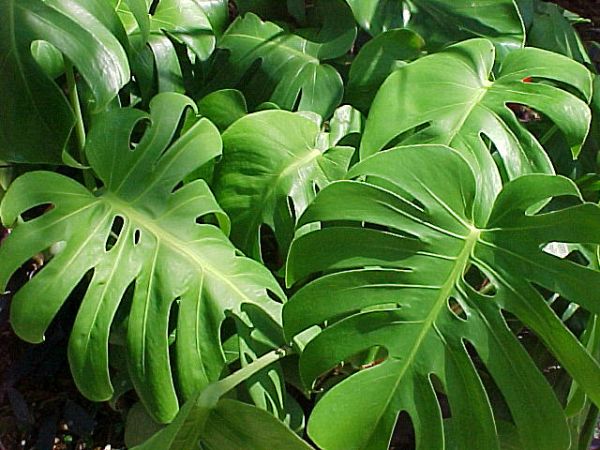
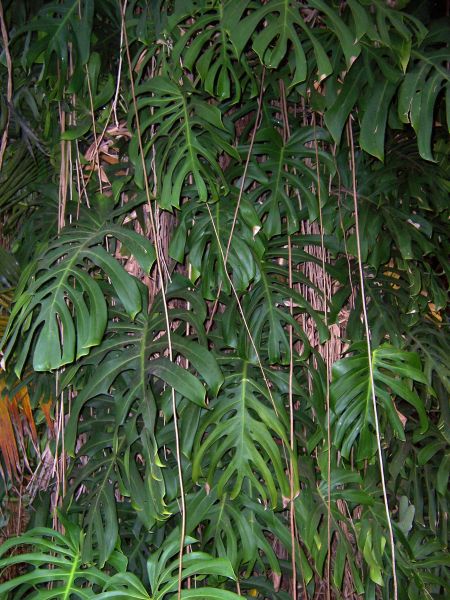
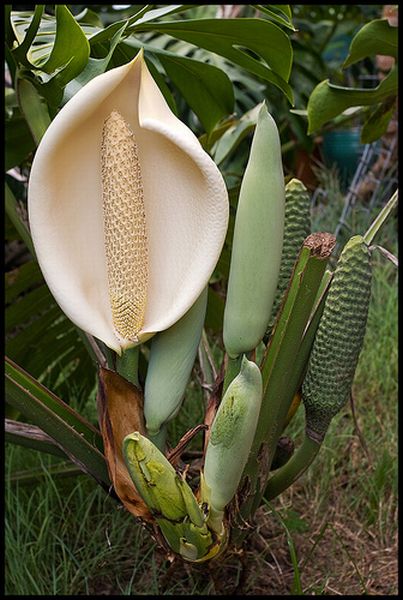
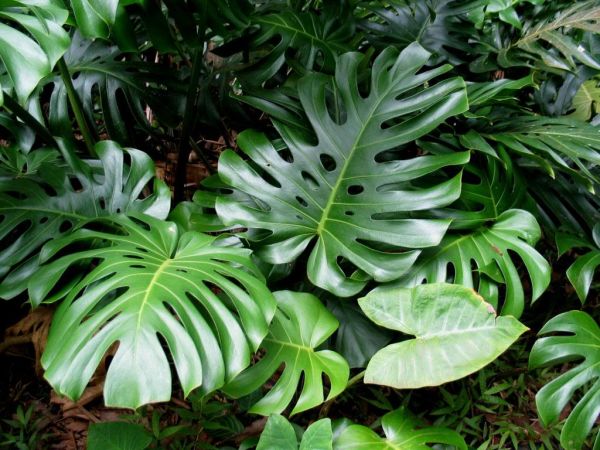
Monstera is one of the most beautiful pot plants, growing wild in South and Central America. It is an evergreen, semi-epiphytic, shrubby climber comprising more than 20 species. Its leaves are large, heart-shaped and leathery, becoming deeply cut with age and developing holes in the leaf blade. Some plants have long, hanging aerial roots. The inflorescence is a spadix surrounded by a spathe, which appears on older specimens, though not often. Monstera fruits are edible, but a certain compound in them can irritate the mucous membranes, so it is advisable not to eat them.
The most popular monstera is Monstera deliciosa, with huge shield-shaped leaves on long stalks, with deep cuts and rounded holes, which can reach up to 100 cm across. This species grows up to 200 cm tall.
The form Monstera deliciosa 'Borsigiana' is a little smaller and has a slimmer habit, so it is better suited to smaller rooms.
There is also a variety with white patches on the leaves. Also worth noting is Monstera pertusa, which grows quickly and has a dense habit, with oval holes of various sizes along the main vein of the leaves. Very attractive too is Monstera obliqua, which stands out with huge openings in the leaf blade and no cuts along its edges.
Requirements
Monstera is not very demanding and is fairly easy to grow. Although these are tropical plants, they tolerate indoor conditions very well. It needs a bright to partially shaded position and does not tolerate direct sun.
Propagation
Monstera is propagated by stem cuttings, leaf cuttings with a bud, and trunk sections. Root them in high air humidity at a compost temperature of 25–30°C.
Care
A temperature of 18–22°C encourages faster growth, but it also tolerates a lower temperature of 15°C, though it then grows slowly. Compost: standard potting compost or a peat-based mix. It likes constant, moderate moisture; in summer water regularly and generously with lukewarm water, and moderately in winter. In summer the leaves can be misted with lime-free water, which is good for the plant and makes the leaves glossy. Feed monstera moderately every week from March to August. Repotting is best done before the plant starts producing new leaves, i.e. in March–April: small plants every year, older ones every 2–3 years.
When a monstera becomes too tall, or loses its lower leaves as it grows, it can be shortened. This involves cutting off the top part of the plant below a point where many aerial roots grow, then planting it in a pot.
When plants get sick
A position that is too shady results in thickened leaves.
Discoloured leaves are caused by lack of water.
It is susceptible to aphids, mealybugs and scale insects. Do not cut off the aerial roots.