Description
Cycas revoluta comes from Java, China and Japan. These plants are dioecious, with separate female and male specimens.
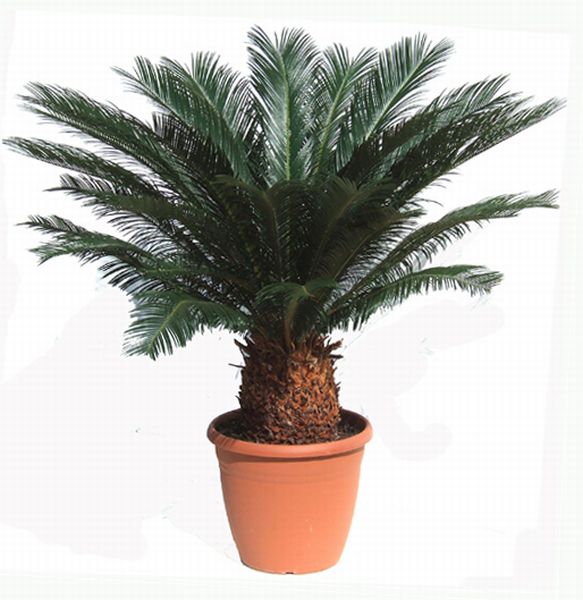
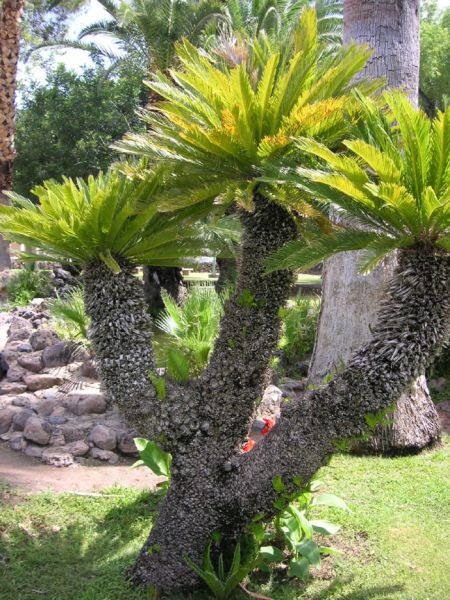
It has a very regular habit. A crown of dark green fronds grows from the top of a stout trunk. It grows very slowly, producing 1–2 new fronds a year, and reaches 6–7 m only after 50–100 years. In young plants the trunk is sunk in the ground; with age it slowly grows into a trunk 20 cm in diameter and up to 7 m tall. The trunk can branch, producing a plume of fronds at the top of each branch.
The dark, rich green, pinnately divided fronds form a rosette at the top of the trunk. In mature plants they are 50–150 cm long. The crowded, narrow leaflets are 8–18 cm long with rolled-under edges (hence the species name). The leaflets at the base of the frond are modified into spines. The leaf stalk is 6–10 cm long and covered with small spines.
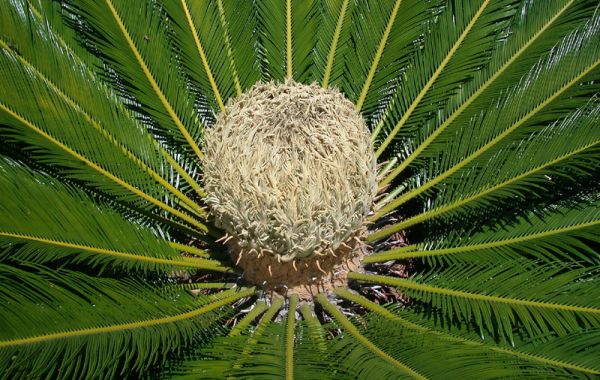
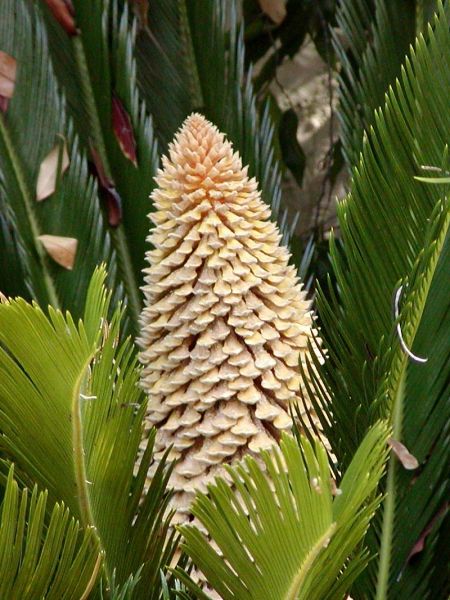
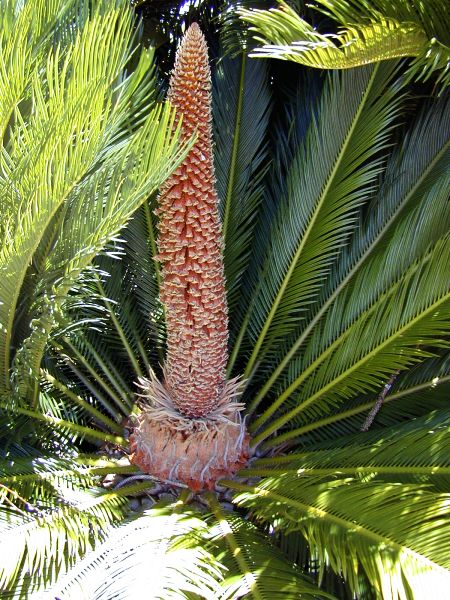
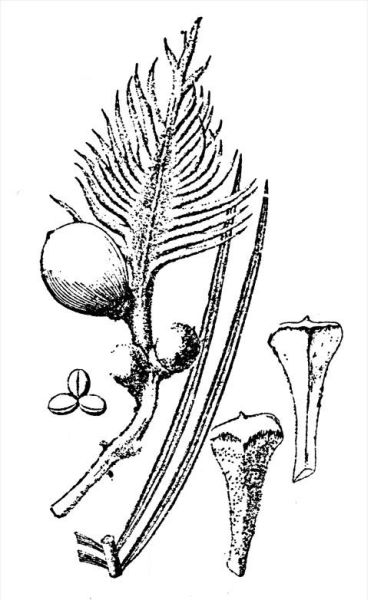
Golden-yellow cones and fruiting structures appear in the centre of the plant. The orange or red seeds take a long time to germinate. Male plants produce cone-like clusters of microsporophylls, while female plants develop a group of megasporophylls. Indoors it does not produce cones.
Requirements
Cycas needs plenty of light. It is also a good idea to give it fresh air from time to time. It is tough and tolerates centrally heated rooms. The sago palm does not need high temperatures.
Propagation
The sago palm can be propagated from seed, from side shoots or from pieces of trunk. Propagation is very difficult.
From seed.
Within a month of the seeds ripening, sow them in a shallow container in a mix of potting compost and sand. The best germination temperature is 25–30°C. The seeds may sprout only after several months. After two or three months, transplant the seedlings and keep them in partial shade.
From side shoots.
Older plants often produce side shoots at the base of the trunk. These can be cut off and used for propagation. To stop the shoots losing too much water, remove the larger fronds. Plant the shoot in soil and keep the pot constantly at 30°C until it roots after several months.
From pieces of trunk.
The trunk produces roots in the same way as the side shoots. Whichever method you use, propagation is always very difficult. It is far simpler to go to a florist and buy a ready-grown plant.
Care
Water the sago palm once every 10 days. Do not let the soil dry out completely – the plant is related to ferns (though often mistaken for a palm). Also mist the leaves, on average twice a week. In winter water very rarely (the so-called rest period), on average once a month. The plant needs humid air. Heavy watering is not advisable, nor is heavy feeding. Feed once a month from April to October.
It needs a fairly bright position, but the sago palm must not be exposed to strong direct sun. Indoors it may not get enough light, especially in a dark room. The plant can be put in the garden, on a terrace or balcony in full sun only after first getting it used to strong light. After winter it must be gradually accustomed to the sun.
Ordinary potting compost from a shop suits the sago palm, but it is best to add plenty of coarse sand. You can also use a special palm compost. The pot should not be too large, as sago palms grow poorly in big pots: its diameter should be only slightly larger than that of the "bulb". Repot only when the trunk has grown so wide that it fills almost the whole width of the pot.
Repot only young plants, which usually grow in very small pots. Older specimens do not like being disturbed; move them to a slightly larger pot once every 4–6 years. When repotting, do not damage the roots – ideally, do not touch them at all.
When plants get sick
Thrips – the leaves lose their colour and silvery spots appear on them. The only way to get rid of the pest is to spray with a suitable insecticide.
White coating on part or all of the "bulb" – this happens when the plant is overwatered. The simplest remedy is to wipe off the coating (e.g. with a brush). You can also water the compost with a fungicide.
If the plant does not grow and its leaves turn yellow – it has too much water and too little light. Water less and move the plant to a well-lit spot.
Before you buy
The sago palm should have undamaged buds of fresh dark green fronds.
Average lifespan: – it can live a very long time.
Difficulty of care: – an easy plant to grow.