Description
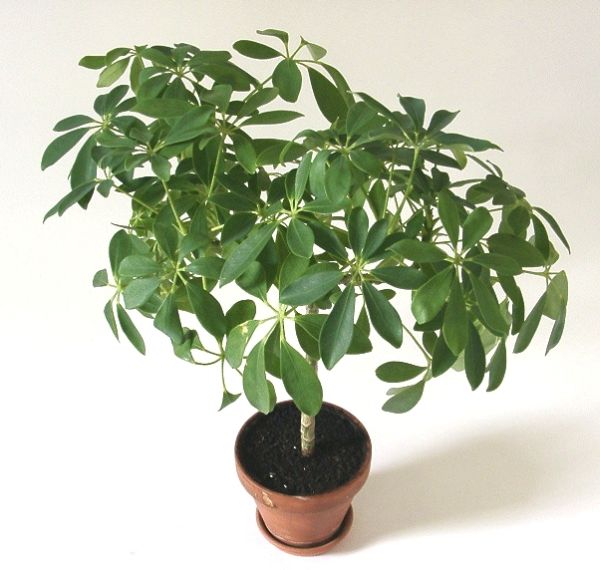
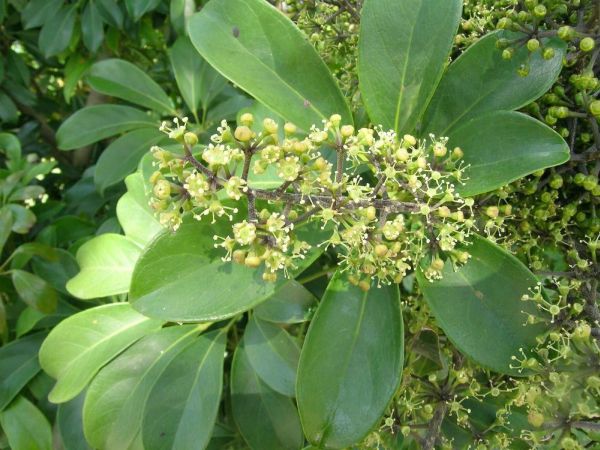
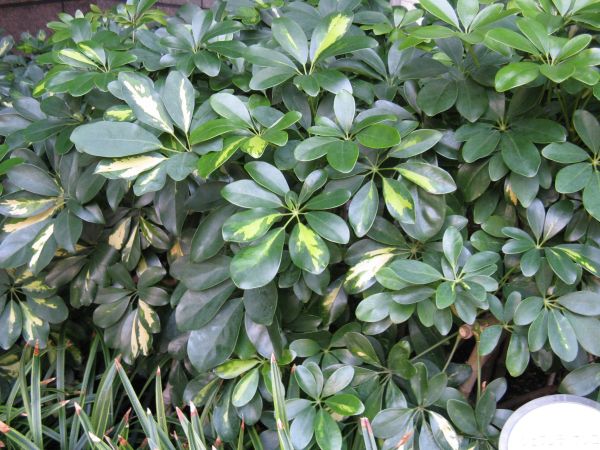
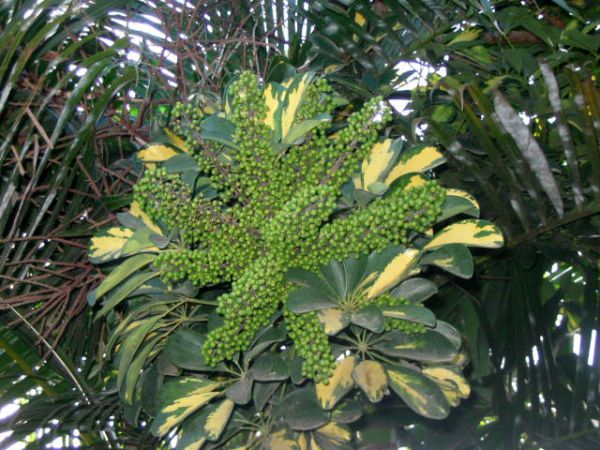
This very popular plant comes from tropical and subtropical Asia, Australia and New Guinea. Scheffleras are evergreen shrubs or trees with palmate, very glossy leaves. The genus Schefflera includes very many species, though two are most popular: Schefflera actinophylla and Schefflera arboricola. In the wild it reaches up to 30 m in height, and much less in pots – up to 200 cm. It has a springy, upright trunk with long-stalked, finger-like leaves up to 30 cm wide, four-lobed at first and with up to sixteen leaflets over the years. In the wild it produces tiny flowers in long inflorescences, but it does not flower indoors. Breeding has produced forms with spotted and speckled leaves.
Requirements
Schefflera needs a bright to partially shaded position, protected in summer from full sun, which turns the leaves yellow.
Propagation
Schefflera arboricola is fairly easy to propagate from tip and stem cuttings. Rooting cuttings need moist, warm compost; cover the container with film with a few holes in it. Air layering can also be used. Schefflera is excellent for hydroponics, and its popularity is visible everywhere – offices, stairwells, entrance halls and conservatories are where you most often see it.
Care
At the end of May, after hardening off, schefflera can be put outdoors in a sheltered spot protected from scorching sun. The temperature in summer should be 15–21°C and in winter 12–16°C; variegated varieties need higher temperatures. A peat-based mix or standard potting compost is suitable. Scheffleras need regular, moderate watering so that the compost is always slightly moist. Avoid waterlogging, as the plant is very sensitive to it. Water less in winter. Schefflera does not have high air humidity requirements, but if it stands near a radiator, mist it occasionally with soft water. Feed every two weeks from March to August, and much less afterwards. Repot every year or two. It is good to cut back plants, which encourages them to branch.
When plants get sick
The plant is susceptible to scale insects and spider mites, especially in a position that is too warm and dry.
NOTE: Schefflera contains substances that can irritate the skin and mucous membranes.