
Description
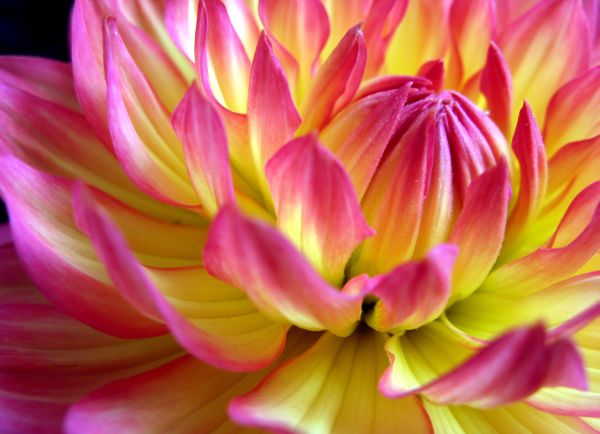
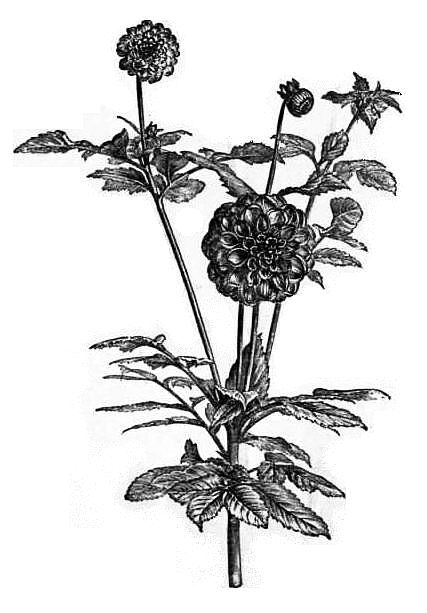
Dahlias, also called georginas, belong to the daisy family and come from Mexico and Guatemala. They appeared in Europe in the second half of the 18th century, and their name honours the Swedish botanist Anders Dahl.
Breeding has produced thousands of varieties of these flowers, and it is hard to find another group of plants with such a wealth of forms.
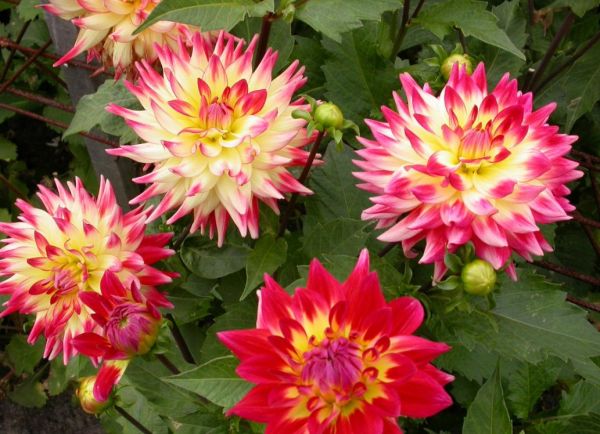
Dahlias are 20–150 cm tall depending on the form, with tuberous roots, thick, branched, hollow stems and pinnate leaves. The flower heads sit on long stalks and come in various sizes and almost every colour. All hybrid dahlias are classed as Dahlia × cultorum – the garden dahlia.
Dahlias are divided into the following groups:
Cactus and semi-cactus – very bushy, 0.9–1.2 m tall, with numerous flower heads 13–20 cm across, filled with ray florets rolled into quills, appearing from July until late autumn; they do not need support.
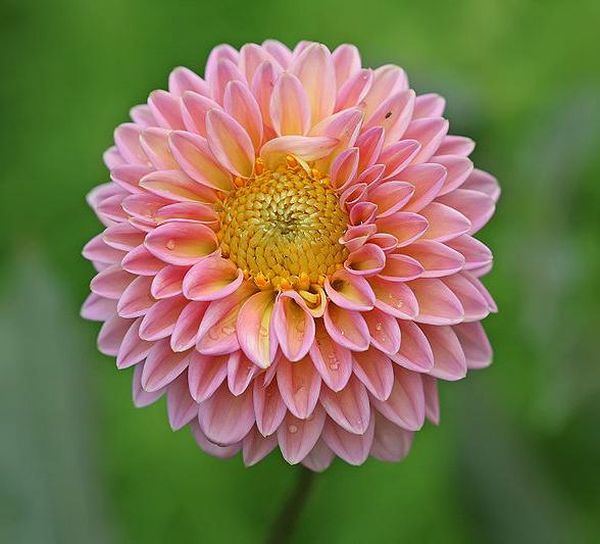
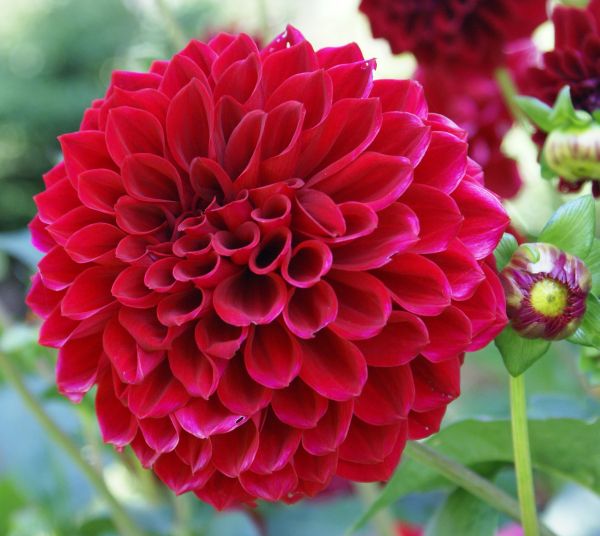
Decorative – 0.9–1.2 m tall, with upright, stiff stems ending in flower heads 12–18 cm across, made up of overlapping, tile-like ray florets.
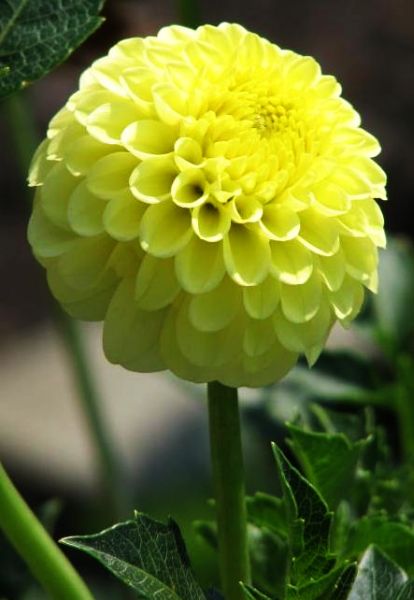
Ball – 70–80 cm tall, with regular, globe-shaped flower heads 6–10 cm across, tightly filled with spoon-shaped, incurved ray florets.
Pompon – similar to ball dahlias in height and flower structure, very bushy, 60–80 cm tall, with numerous small pompon flower heads up to 6 cm across on thin but stiff stems.
Bedding decorative – 40–60 cm tall and very bushy. They flower profusely, producing numerous flower heads 7–9 cm across made of flat, overlapping ray florets.
Bedding cactus – 40–60 cm tall, producing numerous flower heads 12–13 cm across filled with ray florets rolled into quills.
Collerette – with interestingly structured flower heads 6–8 cm across; the ray florets are arranged in two whorls: the outer one large and colourful, the inner one of shorter, narrower florets forming a yellow or white collar, usually around yellow disc florets in the centre. The plants are 30–40 cm tall and recommended for pots, boxes and low flower borders.
Single bedding – flowers 7–9 cm across with a single whorl of ray florets; the numerous disc florets in the centre are usually dark yellow. The plants are 35–45 cm tall and look best in large groups in low borders and in larger containers.
Anemone-flowered – the flower heads have a single whorl of coloured ray florets, and the centre is filled with enlarged, coloured disc florets; the plants are 30–35 cm tall, with flower heads 6–8 cm across. Suitable for balcony boxes.
Top-Mix – plants 25–30 cm tall with numerous small flower heads 4–5 cm across with a single whorl of ray florets. Excellent for small pots, containers, balcony boxes and low borders.
Requirements
Dahlias need fertile, free-draining, not too heavy and not too wet soil. They grow and flower best in a sunny position. Dahlias are short-day plants: when the day length is 10–12 hours, they form more flower heads than at the beginning of summer when the days are longer. Long days, on the other hand, encourage the plants to bush out.
Propagation
Cuttings are a very productive method: shoots a few centimetres long are taken with a so-called heel and rooted in perlite or sand at 20°C. The cuttings are taken from tubers planted in February under cover in a soil-peat mix. Use a rooting hormone. Once rooted, the plants are grown on at 14–18°C.
A more popular method is dividing the tuber clumps, done just before planting, making sure each piece has at least one well-developed bud. This method can at most triple the number of plants.
Propagation from seed is possible only for some single dahlias, e.g. 'Top-Mix'. Sow in February–March at a germination temperature of 18–20°C, and prick out after 2–3 weeks. As the plants grow, harden them off to lower temperatures.
Care
Plant dahlias outdoors after the spring frosts, in the second half of May, at a spacing depending on the form: very tall 80–100 cm, tall 70 cm, low 30–40 cm, dwarf 15–20 cm. Removing faded flowers results in finer and longer flowering. Feed moderately and be careful not to overdo the nitrogen, as too much makes the plant grow too lush and flower less. Tall varieties in windy positions need staking. For the winter, after the first frosts, lift the plants, cut the stems back to 10–20 cm above the ground, and after drying the tuber clumps briefly, store them in a frost-free room at 5–8°C. If the room is dry, cover them with sawdust, peat or sand. Check them over winter and remove any diseased tubers.
When plants get sick
Dahlias are susceptible to viral diseases (dahlia mosaic), fungal diseases (grey mould, sclerotinia rot, leaf smut) and pests (aphids, earwigs, slugs).