
Description
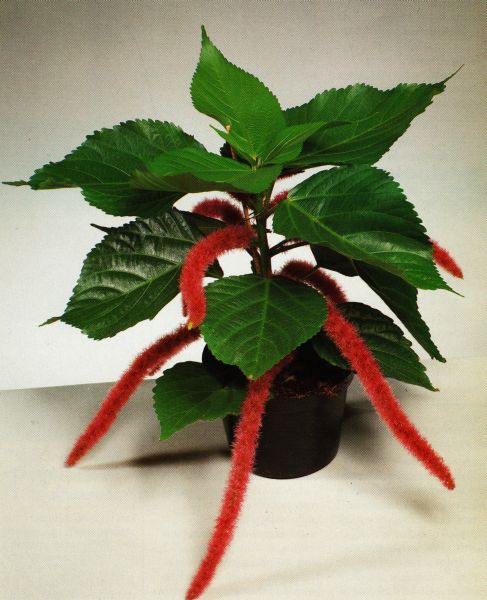
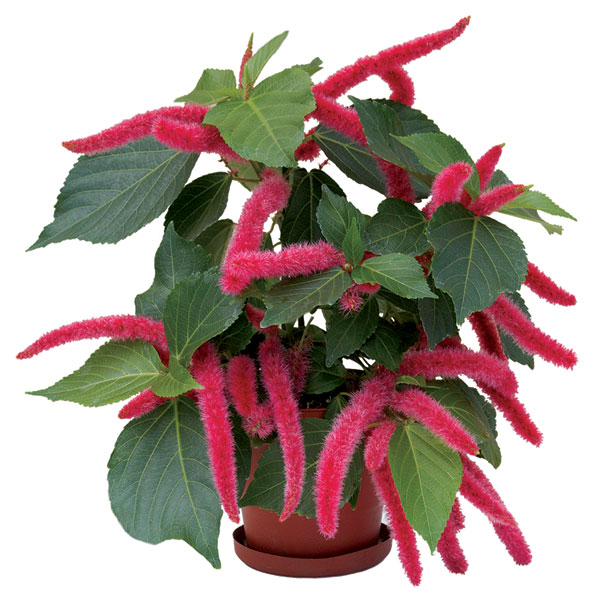
It is hard to find a plant like the chenille plant, with its long red flower spikes. The rounded, spreading varieties bred for hanging baskets look especially beautiful.
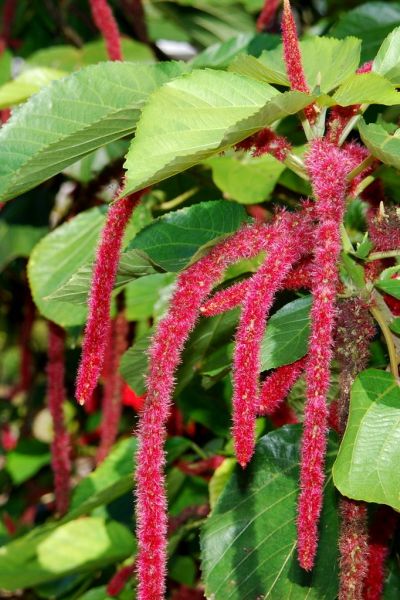
It comes from humid tropical regions – India, the islands of the Australian archipelago and New Guinea – where it grows as a shrub up to 2 m tall.
The flowers of Acalypha need not always be red. There is an 'Alba' variety with chalk-white flowers. There are also forms without flower spikes, and some whose flowers are so small that they are almost invisible under the leaves. Among the many species of this genus there are also plants that look completely different, some deceptively similar to cacti. Their only common feature is the poisonous white sap that all members of this family contain. The sap also irritates the skin, so wear gloves when pruning the plant. Note that not only the sap but other parts of the plant are poisonous too.
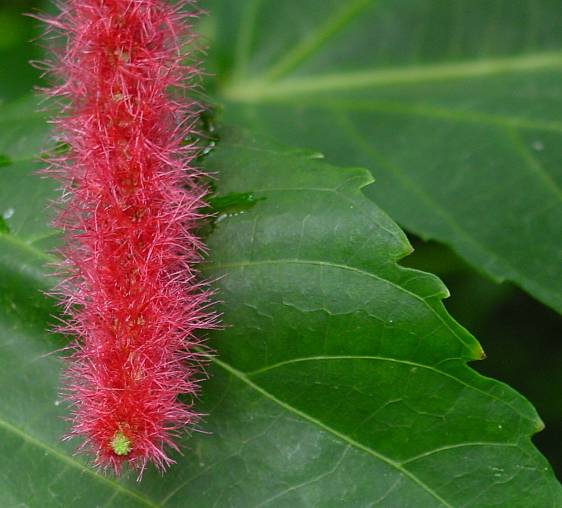
Indoors the chenille plant grows to about half a metre tall. It grows fairly quickly and often needs support. From March to September the plant produces eye-catching long red catkin-like spikes made up of countless tiny flowers. The flowers have no scent. The leaves are often multicoloured, with brown and red tints. If the plant gets too little light, they turn dark green.
Requirements
Acalypha is a fairly demanding plant that must not be kept too cool and needs plenty of light. Place it on a south- or west-facing window or in an enclosed porch. The root ball must not dry out, so regular watering and feeding are needed.
Propagation
The most luxuriant plants are obtained by propagating from tip cuttings or by cutting the mother plant back by half in spring.
In spring, cut about 10 cm tips from young, strong shoots and plant them in a mix of sand and soil. They need a humid, warm environment, for example a cold frame or propagator, and a soil temperature of 21°C. They root especially quickly if a rooting hormone is used. After 2–3 weeks the plants can be moved into normal potting mix.
Care
Indoors, provide plenty of light and high air humidity. The plant cannot tolerate the heat of the midday sun. The most suitable temperature in summer is 20–21°C; in winter it should not fall below 15°C.
Acalypha grows and flowers best when the root ball is constantly moist. This means watering generously in summer and a little less in winter. Half an hour after watering, pour away any excess water from the saucer. During the growing season feed every 14 days with a normal dose of liquid fertiliser. Do not feed in winter. Maintain high humidity by misting often.
Repot every year in March, using ordinary flower compost or a peat-based mix. Peat is suitable for cuttings.
When plants get sick
Leaves turn yellow and drop – usually because of a lack of nutrients. It may also be caused by cold, drought or draughts. Make sure the root ball stays moist. The plant needs plenty of light and warmth but cannot tolerate strong sun.
Spider mites – the main enemy of Acalypha. Never place the plant next to a heat source, where spider mites thrive. They usually sit on the undersides of the leaves. The first signs are discolouration and spots. Spraying with an insecticide works well. If the plant is badly infested, get rid of it before it infects others.
Before you buy
It is best to buy a chenille plant with new flower tails that have not yet developed. Fresh green leaves are a sign of good health.
Average lifespan: the plant becomes less attractive over time, but it can live a long time.
Difficulty of care: a fairly demanding plant.