Description
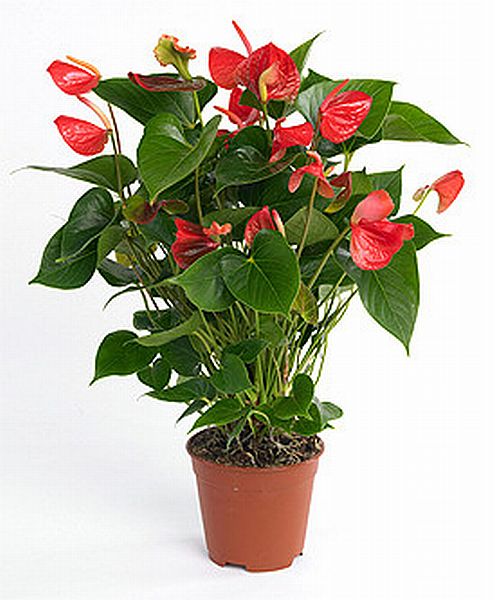
Anthurium andreanum is a well-known houseplant grown to brighten interiors. The flowers of greenhouse-grown plants are extremely popular as cut flowers.
The plant reaches 50–70 cm in height. It has short stems; the aerial roots growing from the nodes are exposed in the upper part and support the lengthening stem (they break easily). The elongated heart-shaped leaves, up to 30–40 cm long, sit on stalks as long as the leaf blade.
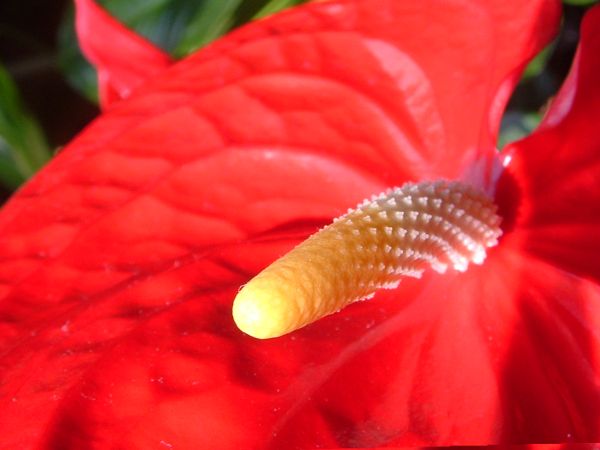
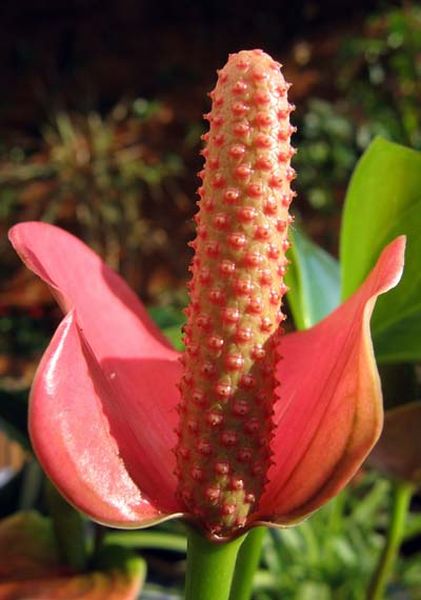
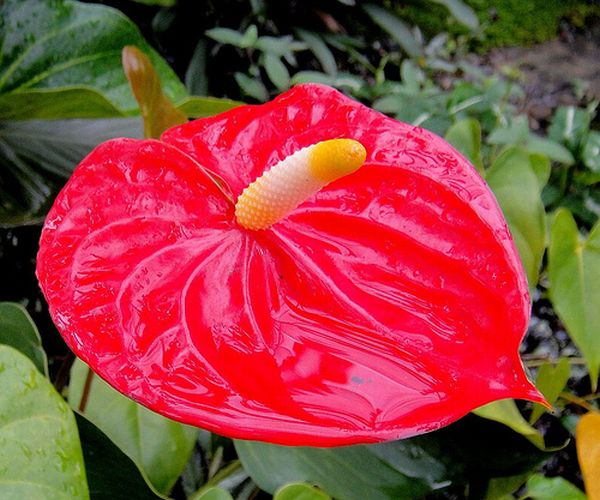
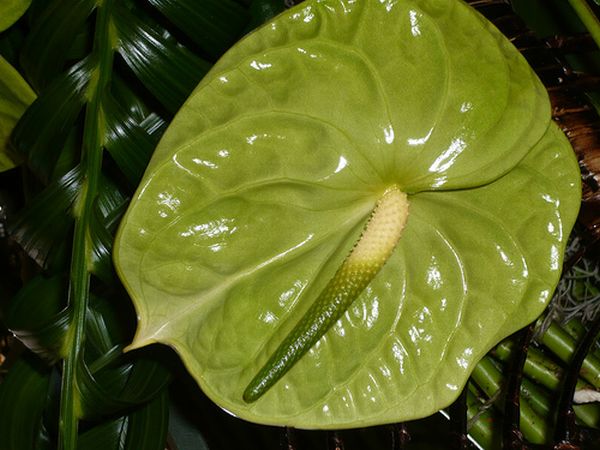
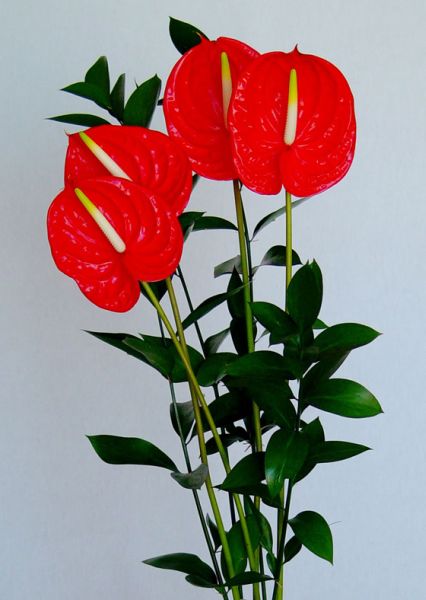
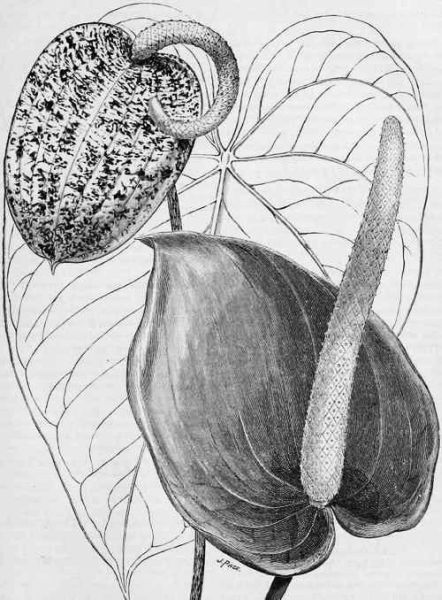
The ornamental part of the anthurium is the spathe on a long stalk surrounding the flower spike, called the spadix. The spathe is broad, heart-shaped, with a blistered surface, and comes in various colours depending on the variety. The spadix is 6–10 cm long, straight or slightly curved, and bears tightly packed bisexual flowers with a greatly reduced perianth. The main flowering season is from February to June, but individual flower stems appear all year round.
Requirements
During the growing season, from March to September, anthuriums need fairly high air humidity. All species and varieties need a warm, bright position, though protected from direct sun – for example an east- or north-east-facing window.
Propagation
When new shoots appear, propagate by division or by seed. With seed you must expect a long wait, as these plants develop slowly. A very common method is also rooting pieces of stem; this requires a heated propagator filled half with coarse sand and half with fibrous peat. The temperature in the propagator should be 25–35°C.
Care
During the growing season, from March to September, anthuriums need fairly high air humidity. All species and varieties need a warm, bright position, though protected from direct sun – for example an east- or north-east-facing window. Anthurium crystallinum grows well only in a hot greenhouse or a tropical window. Even in winter the temperature of the growing medium should not fall below 18°C, and the air temperature below 15°C. The best medium is a peat-based compost, standardised potting soil, or a mixture of sphagnum moss and compost with added clay. Watering is an important part of growing these plants. During the growing season water generously with lukewarm, soft water. You can use rainwater warmed beforehand, depending on where you live – in heavily industrialised areas this is not advisable. Misting is rather harmful for anthuriums. Anthuriums are very sensitive to salts, so do not overfeed them. It is best to use a hydroponic nutrient solution every 2 weeks; ordinary fertilisers can also be used, but at a dose several times lower than recommended. Repot anthuriums in spring.
When plants get sick
Dry air and too much sun can make the leaves curl; the plant becomes weakened and more vulnerable to spider mites and thrips.
Before you buy
The plant should be in flower. Check that it has no pests.
Average lifespan: – it can live a very long time.
Difficulty of care: – an easy plant to grow.