Description
Hollyhock is a biennial of the mallow family (Malvaceae) originating from China.
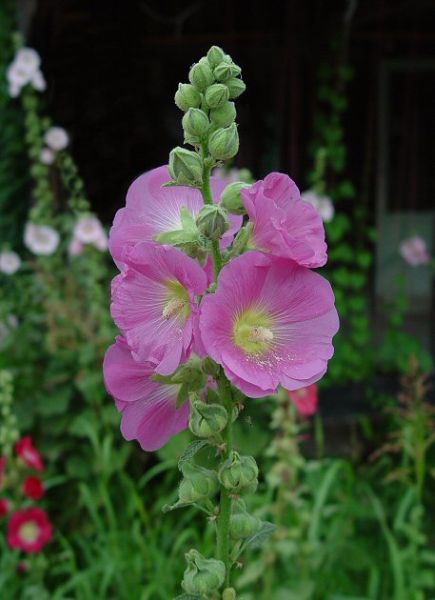
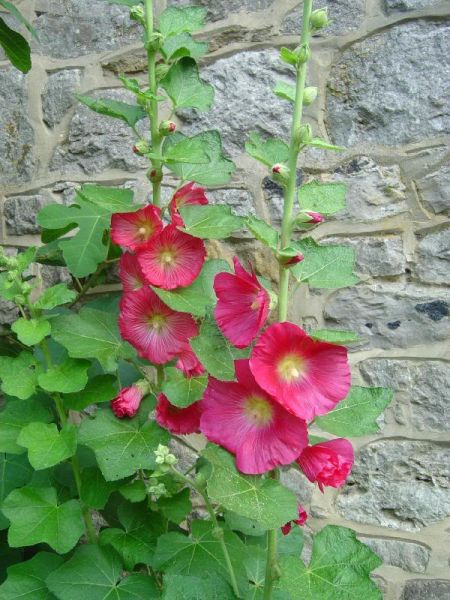
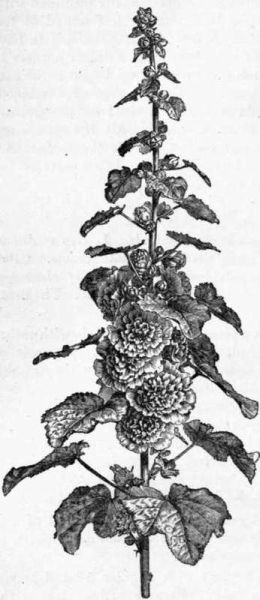
In the first year it forms a rosette of leaves. They are large, not very ornamental, palmately lobed and roughly hairy. In the following year each plant produces 2–4 leafy, roughly hairy main stems 60–250 cm tall. Some way above the base these stems are more or less branched.
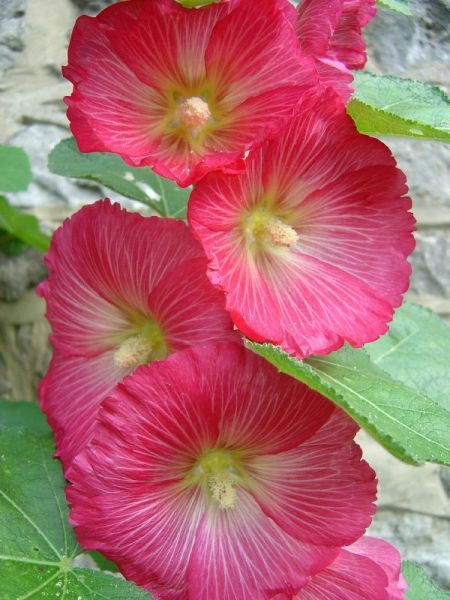
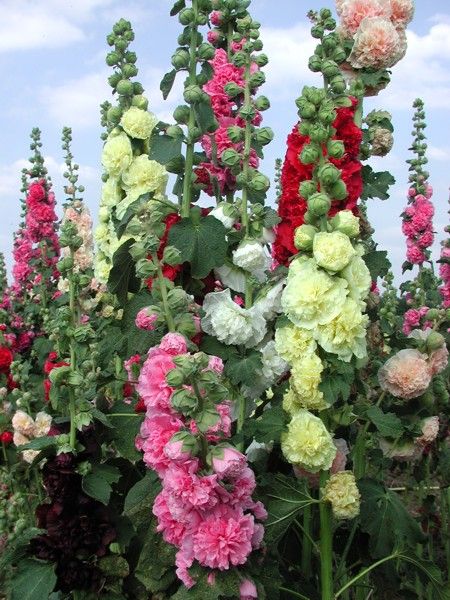
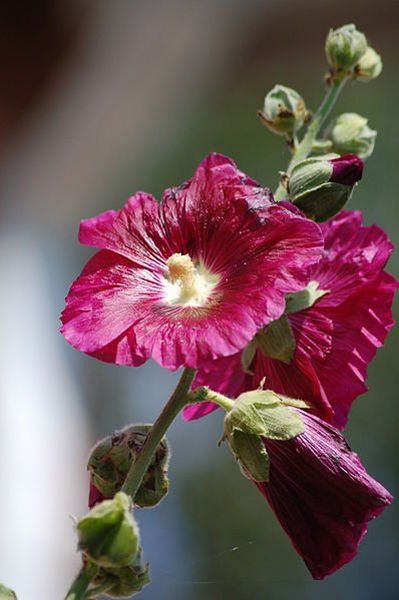
It flowers from July to September. The racemes of flowers appear on the stems in the second year. The single or double flowers, in white, yellow, pink, red or purple in various shades, grow one or two at a time from the axils of the upper leaves.
Mostly double-flowered hybrids are grown. They are divided into 4 groups:
Ordinary double hollyhocks – the outer petals, set in one or two whorls, are longer than the inner ones and surround the densely packed central petals like a ruff, forming a hemisphere. The plants are not very tall.
Scottish hollyhocks – very double flowers, with outer and inner petals of the same length arranged in a semicircle, gathered in long, pointed spikes. The plants are tall.
Chater's hollyhocks – double flowers set in long, very dense, blunt-tipped spikes. The plants are vigorous.
Allegheny hollyhocks – flowers with fringed petal edges. Sometimes the outer petals are a different colour from the inner ones.
Requirements
It needs warm, sunny but sheltered positions and fairly rich soil.
Propagation
It is propagated from seed sown in May–June in a cold frame or a seedbed. The seedlings need pricking out, ideally into peat-and-soil pots. At the end of summer the young plants are planted out in beds at 30 x 30 cm and lightly covered for winter. In spring they are moved to their final position with a large root ball. The flower stems need support.
Care
Water the plants in dry spells, as they are prone to rust. After flowering, the plants can be cut down to ground level. New shoots will then appear and flower the following year – but remember that this flowering will be less impressive than in the second year.
When plants get sick
Rust – the first symptoms are small whitish pustules on the stems and undersides of the leaves, which turn brown over time, while yellow and reddish spots form on the leaves. Such leaves turn brown and die. If symptoms of rust appear, remove the leaves immediately and burn them. Spray the plants with a suitable fungicide. It is best not to wait for the disease to appear, but to spray the plants from early May about every 2 weeks, alternating two different products – about 4 sprays in total.