Description
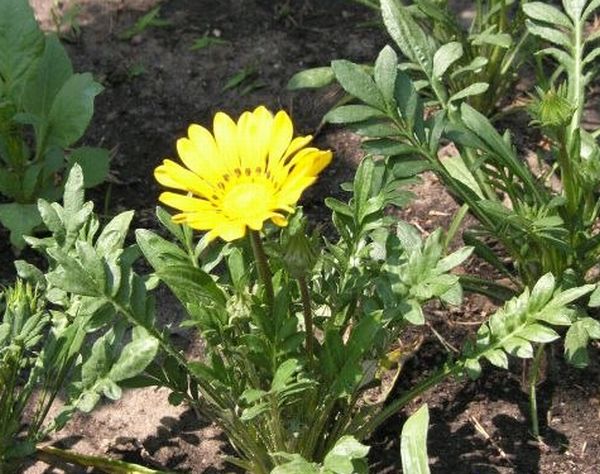
The treasure flower is an annual of the daisy family (Compositae). It is a hybrid created by crossing several species from South Africa. It has very short, branched stems, sprawling at the base and ending in a tuft of upright leaves 5–15 cm long. Each stem ends in a flower head on a long stalk. Second-order shoots grow from the leaf axils of the main stems and branch further. The leaves are elongated, white-felted underneath and roughly hairy on top.
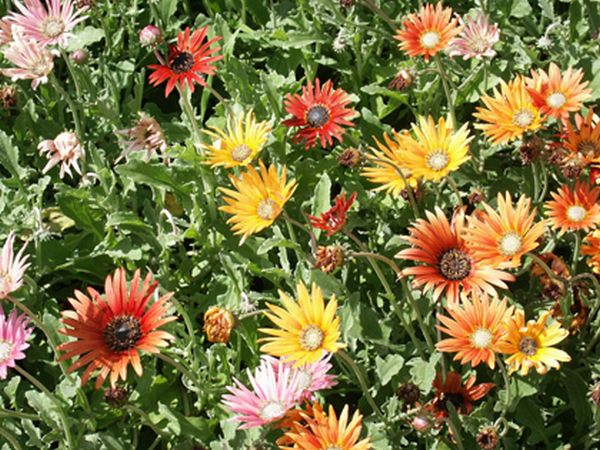
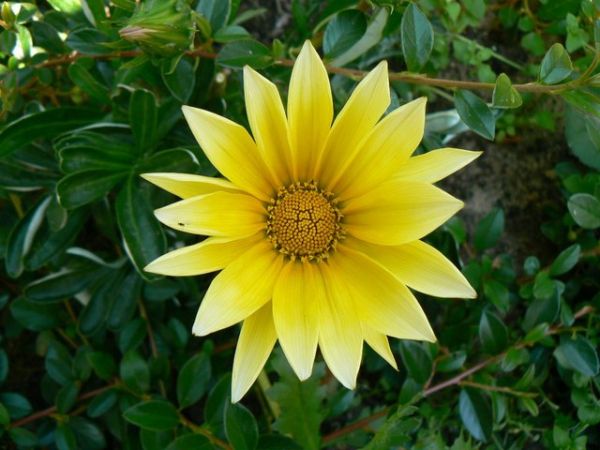
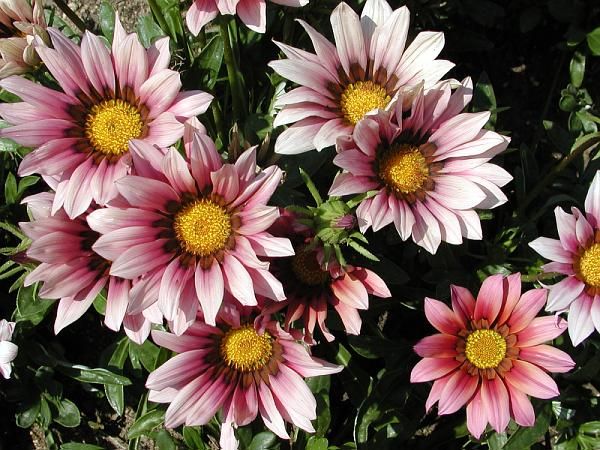
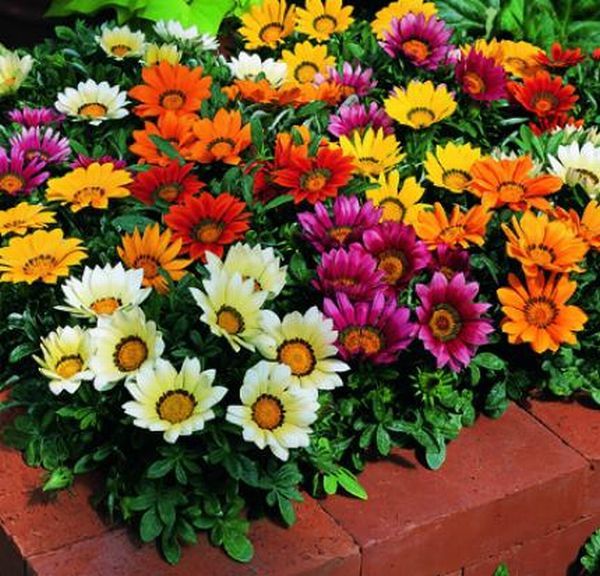
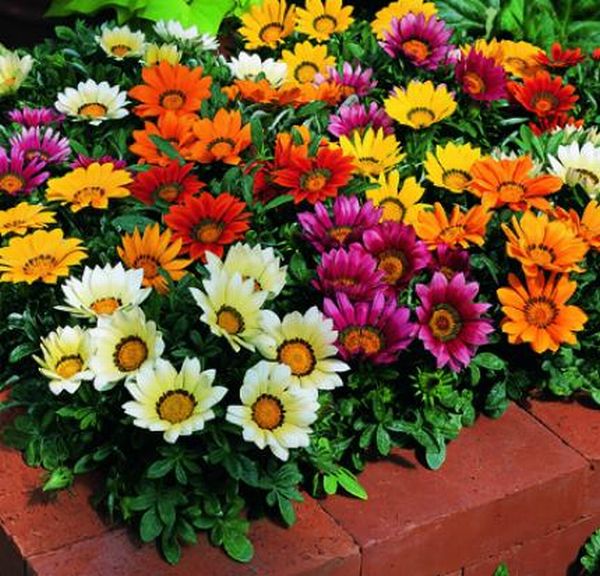
Gazania flowers from the end of June until late autumn. The flowers open only in full sun; on cloudy and rainy days the flower heads stay closed. The flower heads are 8 cm across and consist of coloured ray florets in 1–3 outer rings and yellow disc florets in the centre. The ray florets are yellow, orange, pink or coppery-scarlet, with a black or brown blotch at the base marked with a narrow yellow spot or line.
It is used for edging flower beds, in borders, rock gardens, on low walls and banks.
Requirements
Gazania needs fertile, humus-rich soils that are not over-fertilised, and a sunny position.
Propagation
Gazania is propagated by seed sown in February–March in trays in a greenhouse. The seedlings are pricked out into a cold frame or peat pots. Plant out in the second half of May, after the last frosts, at 30 x 25 cm.
Care
Cut off fading flower heads, as the ripening seed heads are not decorative. The plants are also suitable as cut flowers.