Description
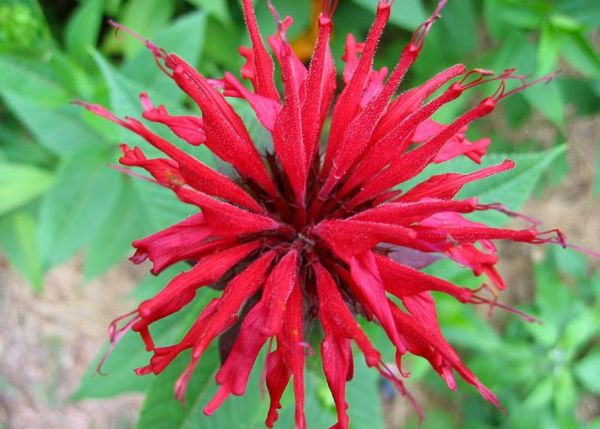
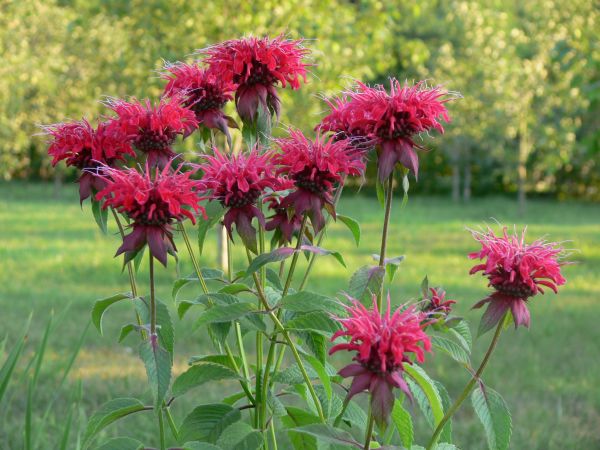
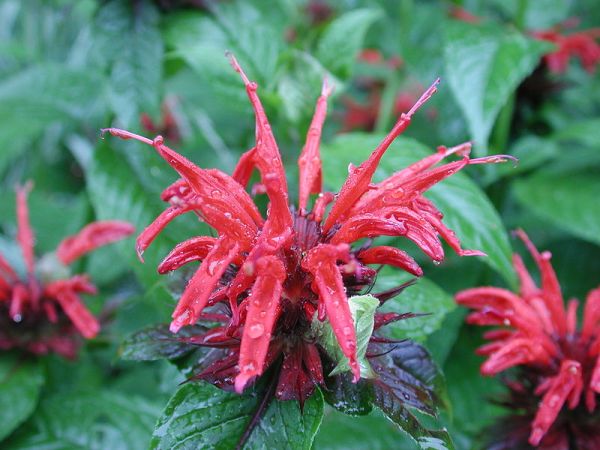
Bee balm is a perennial of the mint family (Labiatae). It is a hybrid of Monarda didyma and Monarda fistulosa, both of which grow wild in North America. The plants produce numerous runners and spread quickly and vigorously. The stems, growing close together, reach 60–100 cm; they are stiff, softly hairy, fairly densely leafy and end in rounded flower heads. The leaves are egg- to lance-shaped, pointed and, like the stems, hairy and aromatic.
Bee balm flowers from the end of June or beginning of July to September. The two-lipped flowers, fused into a long tube, are gathered in heads and often open in whorls. Depending on the variety, the flowers may be pink, red, scarlet or blue.
It is planted in borders, in groups in parks and by the edges of ponds. It is also suitable as a cut flower.
Requirements
The plant likes fertile, moist soil and a sunny or partially shaded position.
Propagation
It is easily propagated by division in spring and autumn, or by cuttings in spring. Plants cut back after the first flowering flower again in autumn.
Care
Water during droughts, as they root very shallowly.