Description
Cymbidium is one of the most popular orchid genera. It comes from the foothills of the Himalayas, so it is adapted to cool growing conditions – something to remember when growing it at home.
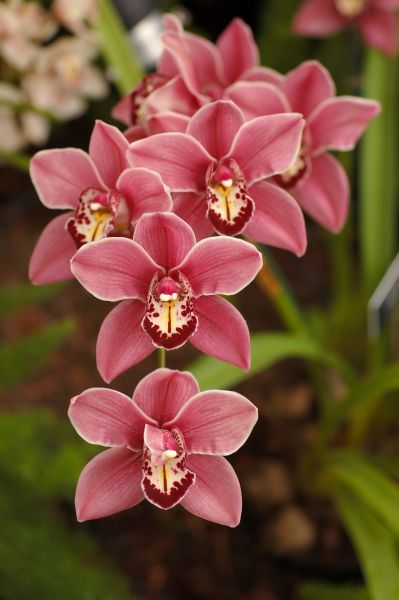
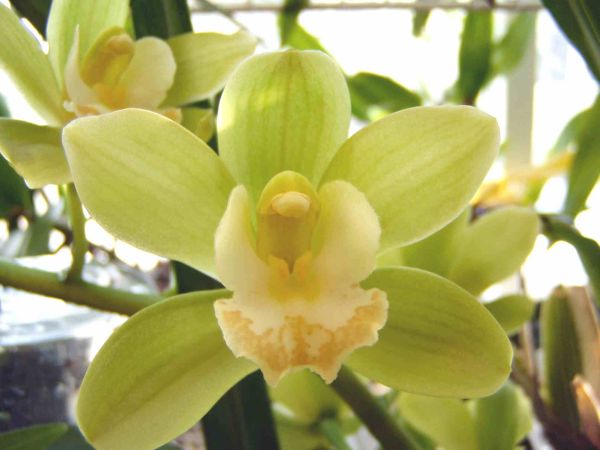
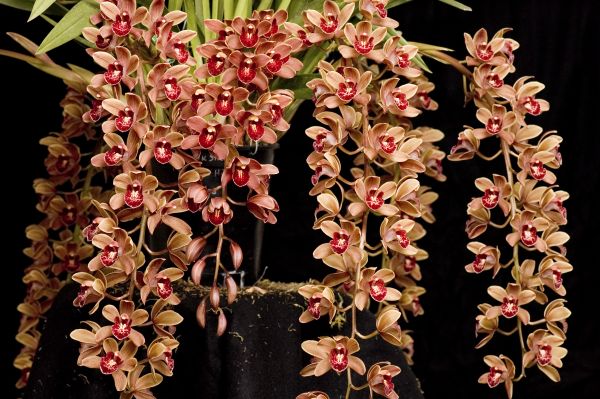
Cymbidium forms short, cylindrical, swollen pseudobulbs surrounded by leaf sheaths. The leaves are long, narrow and leathery. The plant's glory is its long, showy flower spikes on stiff stems, carrying 10–25 flowers 6–15 cm across. Depending on the variety, the flowers vary in shape, size and colour; there are also two-coloured varieties. The flowers have an intensely coloured lip, often purple or spotted. The beautiful sprays are very popular and highly valued as cut flowers, lasting exceptionally long – up to six weeks.
Cymbidium flowers once a year, and the flowers last from 1 to 3 months.
Requirements
These orchids grow well at moderate temperatures, with night-time drops even to 13–15°C, so they can be put out on the balcony or in the garden in summer. Only during the rest period in autumn should they be kept at 10–12°C to stimulate flowering.
Cymbidiums like plenty of light. In our climate they can stand on a south- or west-facing windowsill, and on a balcony or in the garden in summer.
During the growing season the compost should always be slightly moist. Only during the rest period should watering be reduced.
These orchids like being sprayed or misted with soft, lukewarm water, provided there is good ventilation.
Propagation
If you want to divide the plant when repotting, divide it so that each part has three or four green pseudobulbs in addition to the new growth.
Care
For a cymbidium to flower, the night temperature must be lowered below 14°C from the beginning of May to the end of October. It is best to put the plant outside during this period, in a bright place with diffused light, for example under a tree or shrub. In autumn, once the plant has been brought indoors, give it plenty of light – ideally at a south- or east-facing window – but the spot should be cool. Moving plants with developed buds to a warm room above 14°C can make the buds drop in more sensitive varieties.
In spring, summer and autumn water cymbidiums often and generously; in winter water less. Except just after repotting, the compost should be constantly moist. Misting the leaves is also beneficial, but only in fine weather and with water of suitable quality – rainwater or distilled water. From March to September feed every week with an orchid fertiliser, and from October to February once a month with a fertiliser lower in nitrogen.
Repot cymbidiums only when the compost has broken down, as these orchids do not like having their root ball disturbed. The compost should be light and porous, able to hold some moisture but draining perfectly. If the plants need dividing or repotting, do it in spring after flowering. Cymbidiums produce a huge root system and outgrow their pots faster than other orchids. Choose a pot large enough to leave room for at least two years' growth with the plant set in the middle. Carefully remove all dead roots and old compost without damaging the live roots. If it will not harm the plant as a whole, cut out all the old, leafless pseudobulbs when repotting.
When plants get sick
Spider mites often feed on cymbidium leaves. To get rid of them, give the plant a shower with room-temperature water once a month. If the pests still return, spray three times at weekly intervals with a suitable insecticide.