Description
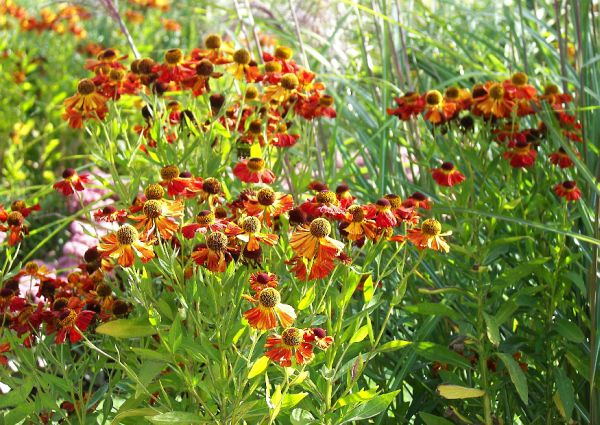
Sneezeweed is a perennial of the aster family from North America; the name mainly covers hybrids of Helenium autumnale. The plant forms a large, strong clump that spreads over time. The stems are upright, furrowed, heavily branched at the top and 50 to as much as 200 cm tall. The leaves are gland-dotted, lance-shaped, toothed and dark green. Unfortunately they tend to dry up, but this is not a problem, as sneezeweed is usually planted at the back of the border because of its height.
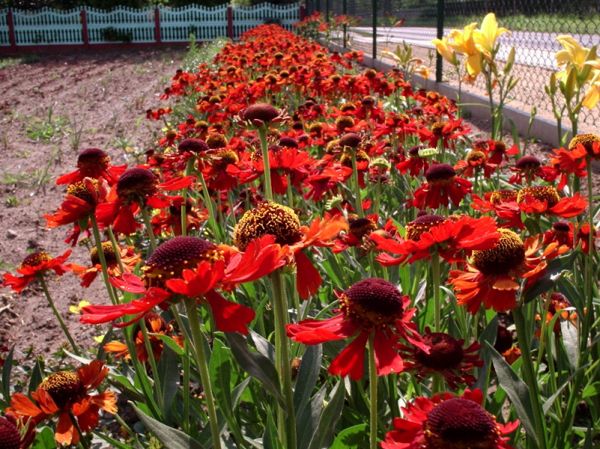
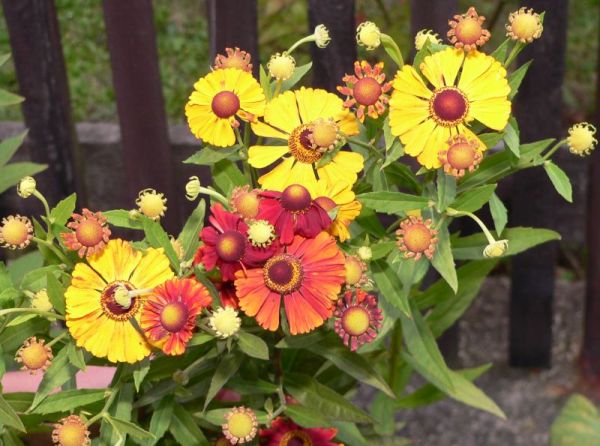
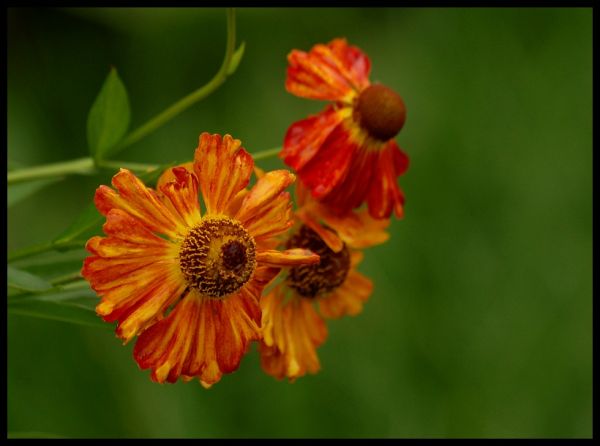
The flower heads are 3 to 5 cm across; the outer ray florets are yellow, yellow-brown or brownish-red, with three distinct teeth at the tip. The yellow or brown disc florets are densely packed, forming a dome in the centre of the flower head. Varieties are available with yellow ray florets, yellow streaked with brown or orange, and red-brown.
Requirements
Sneezeweed is best planted in fertile, free-draining, moderately moist soil. It grows poorly on impermeable clay, barren sand and soils flooded in winter. A position in full sun is ideal.
Propagation
Sneezeweed is propagated by division in spring or autumn. Some varieties can also be propagated from softwood cuttings taken in spring, which root within a week. Do not take cuttings and plant them out in autumn, as young plants will not survive the winter, especially if the weather alternates between rain and frost. In spring cut last year's stems back to just above the soil. Sneezeweed can also be grown from seed sown in May–June in pots or cell trays, in a cold frame or a seedbed. Plant out in the final position in August–September at 50 x 50 cm. Plants raised from seed, however, are not uniform.
Care
The plants grow quickly and lushly, so their stems often flop over onto the ground. To prevent this, tie the plants to stakes. Sneezeweed flowers from July to September. To delay flowering by about two weeks, cut back some of the stems in May or June.
Water during droughts. The plants need feeding. Cut back the flower stems after flowering. Sneezeweed is moderately frost-hardy; some varieties need winter protection.
Tall sneezeweeds look good planted along fences and by the walls of summer houses or other garden buildings. They can also be planted near deciduous and coniferous shrubs. They are ideal for dividing different parts of the garden and are also suitable as cut flowers.