Description
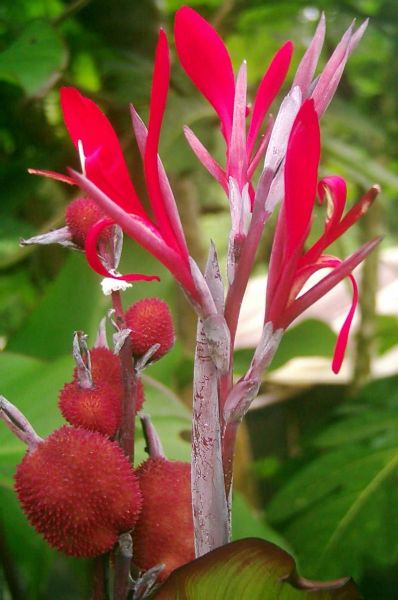
Canna belongs to the canna family and in our climate is grown as an annual. It comes from tropical America, Asia and Africa. Its Polish name comes from the seeds, which resemble beads. There are about 60 species of canna, but only some are grown as ornamental plants, and hybrid forms are the most widespread.
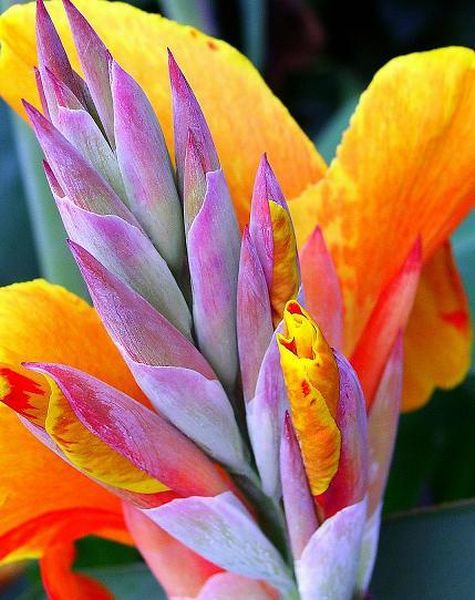
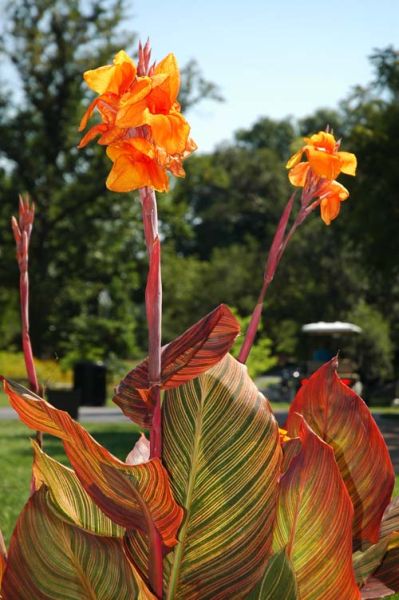
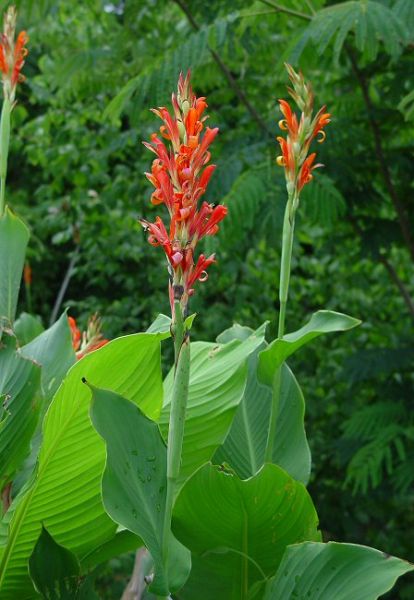
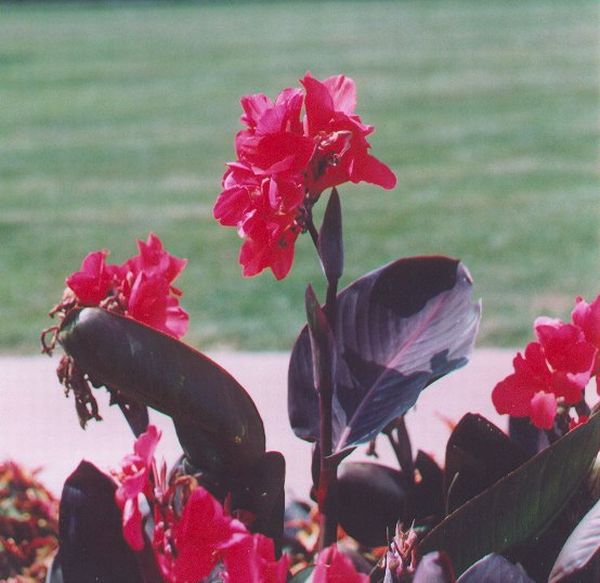
Varieties differ in height and in the colour of their flowers and leaves. They grow 50–150 cm tall and form thick, branching, fleshy rhizomes. The leaves are large, egg- to lance-shaped, green or reddish-brown and decorative. The flowers vary in shape, size and colour and are gathered in spikes at the top of the fleshy stems.
Cannas look good in larger groups, especially in the centre of a border surrounded by other plants. They also suit large containers on terraces, balconies, patios or in the garden.
Requirements
They like sunny positions (at least 6 hours of sunlight) and warm, humus-rich, medium-textured soil rich in nutrients.
Propagation
Cannas are propagated by seed sown in January–February and by dividing the rhizomes in early spring. The seeds have a fairly thick coat – to speed up germination, soak them in warm water before sowing. Prick out the seedlings singly into pots and keep them in a bright place at 18°C. Divide the rhizomes so that each piece has at least one well-developed bud. Dust the cut surfaces well with crushed charcoal.
Care
To get large, beautifully flowering plants in summer and plump rhizomes in autumn, canna should grow for at least 6 months. As our climate does not allow this outdoors, the rhizomes must be planted in containers in March – singly, in a mix of peat, soil and sand. At first place the pots somewhere not necessarily light, at 15°C (it can be a little lower). Water minimally until the leaves appear. Once the leaves appear, give the plants light and raise the temperature: 18–20°C by day and 12–15°C at night. Follow the rule: the less light, the lower the temperature (and vice versa). Cannas are sensitive to low temperatures, so plant them outdoors only when there is no longer any risk of frost, after hardening them off. Plant them in their final position at 40 x 60–80 cm.
Cannas need generous feeding and watering. Rhizome growth depends on proper feeding and watering: if it is poor, in autumn you may end up with smaller rhizomes than those planted in spring. This is because the plant initially draws food from the rhizome planted in spring while building several new rhizomes for the following year. The number of new rhizomes depends on the variety and on feeding. With proper care you will get several new rhizomes in autumn, and the mother rhizome dies. Poor cultivation can also be why a canna does not flower – instead of producing fine flowers, the mother rhizome spends all its energy on growing rhizomes.
Water plants in containers every day, and those in the ground 2–3 times a week, but generously. Feed from the beginning of June to the beginning of September every 8–10 days with a balanced fertiliser for flowering plants. Removing faded flower spikes encourages repeat flowering.
In our climate cannas do not overwinter in the ground, so the rhizomes must be lifted for the winter once the first frost has blackened the leaves. Cut off the top growth 10–15 cm above the ground and gently dig up the rhizome with its root ball. Carefully shake off the excess soil, lay the rhizomes in trays, cover them with moist peat, sand or sawdust and move them to a cool room, not necessarily a light one. Check the rhizomes several times over winter and remove any that are rotting or damaged. In spring divide them so that each piece has at least two buds.