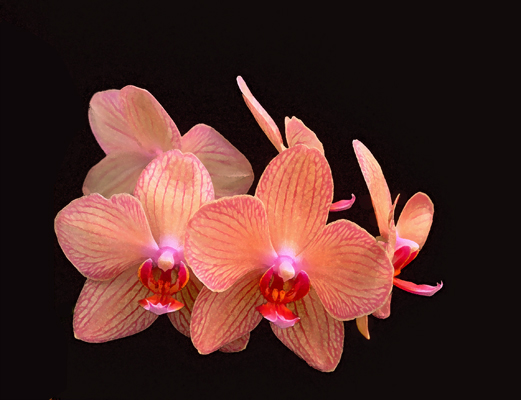
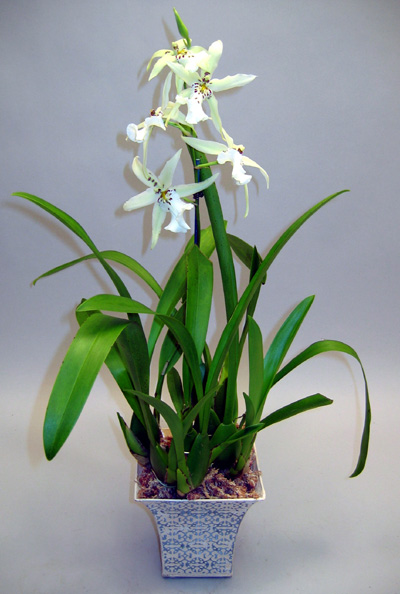
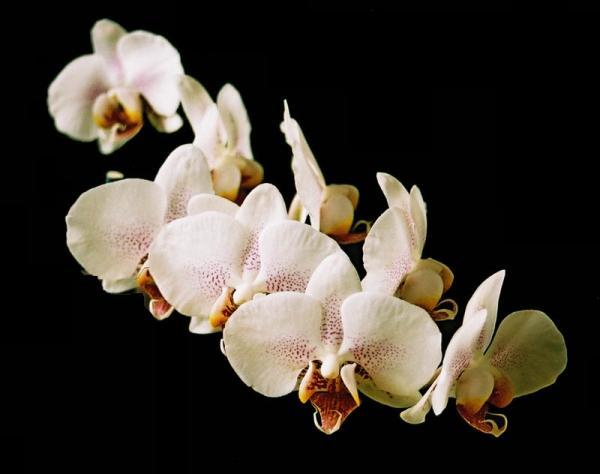
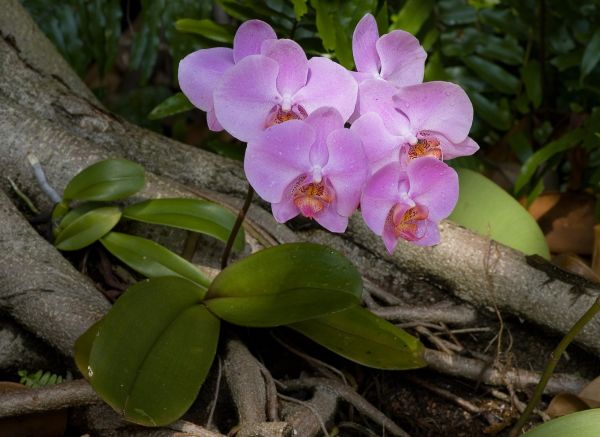
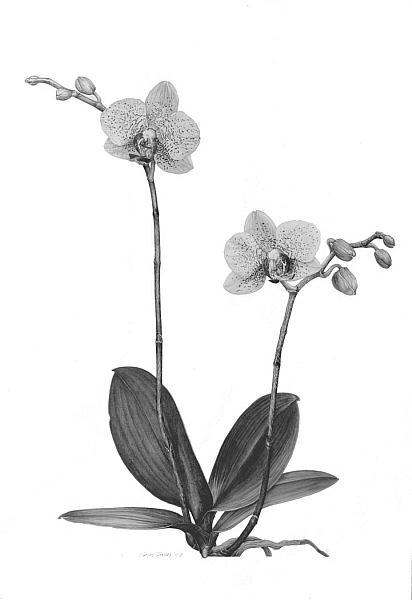
Description
Orchids of the genus Phalaenopsis come from tropical South-East Asia and Australia, where they can be found fairly high above the ground on tree crowns and trunks or on rocks. In the eastern Himalayas they grow on steep, shaded cliffs with very high air humidity.
Most orchids are epiphytes – plants that grow on other plants, which give them a suitable place to grow.
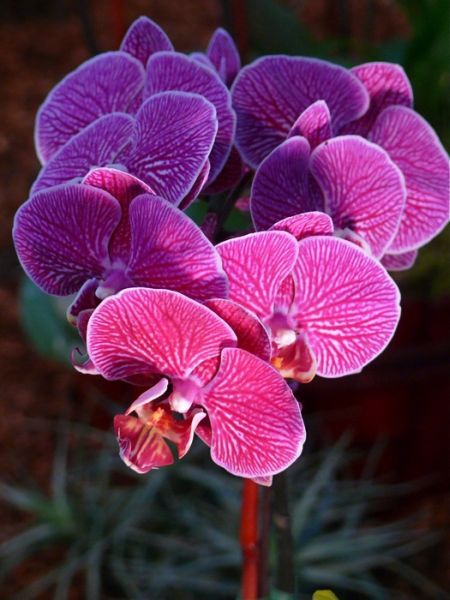
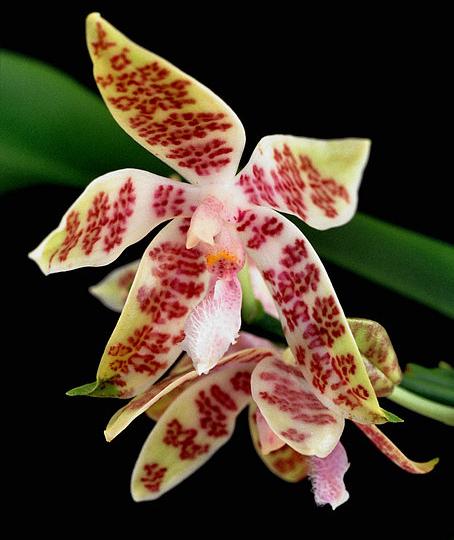
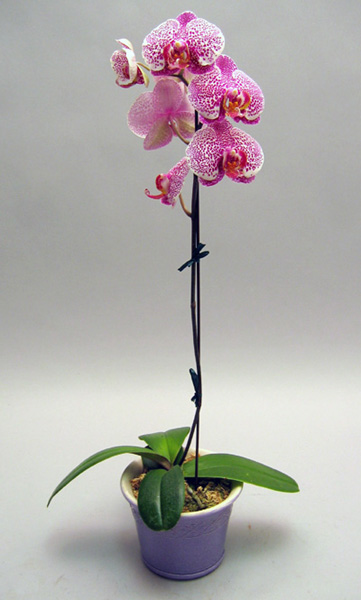
They flower at different times of year depending on the species and variety, and their flowers last on the stems for several weeks. The leaves, growing from a short stem, are thick and leathery. The flower stems can reach 60–150 cm in length, each bearing up to 30 flowers that look like a swarm of butterflies settled on a twig. The flowers of some varieties are fragrant.
There are around 25,000 orchid species, and many are now fairly easy to find in good shops and garden centres. Most Phalaenopsis on sale are hybrids, usually without a specific botanical name.
Light
Phalaenopsis light requirements are easy to meet. The ideal light level is partial shade. You can judge whether the light is right by the leaves. Too little light makes new leaves grow longer and noticeably narrower than their normal oval shape, and dark green instead of slightly yellowish green. Too much light turns them distinctly reddish-maroon. On a windowsill, Phalaenopsis does best at an east-facing window, because early in the day, when the plant receives more light, the temperature is lower. A south-facing window is possible only if the sunlight is filtered so that it does not scorch the plants. At south- or west-facing windows, from May to September, provide some shade, for example with a thin curtain or blinds. Always make sure the midday sun never falls directly on the leaves. In the Polish climate, from early December to mid-February, even full sun is acceptable.
Phalaenopsis also grows well under artificial light, e.g. fluorescent tubes (25–50 cm from the tube) or a sodium or HQI lamp (Son Agro or another horticultural lamp) at a distance of about 1 metre. The length of the artificial day depends on the season: 11 hours in winter, 14–16 hours in summer.
Temperature
Phalaenopsis are South Asian plants from a fairly warm climate. The ideal night temperature is 16–18°C and the day temperature 21–27°C. Most of our homes provide this range, which is why they are ideal houseplants.
In summer the plants usually tolerate somewhat higher temperatures, though overheating plants exposed to full midday summer sun can kill them. If temperatures on the windowsill stay above 35°C in summer, shading (e.g. with blinds) or moving the plants is absolutely essential.
In winter be careful when airing the room during frosts – a strong draught of air at 0°C or below can freeze the leaves, which then become glassy and wilt. Severe frost damage can kill the whole plant. Temperature shock (also when transporting plants in winter) can make flowers and buds drop.
Air humidity
Phalaenopsis are monopodial orchids without pseudobulbs to store water, so suitable humidity is important. 50–70% humidity is ideal. If the plant is watered well, however, it can adapt to lower humidity. Phalaenopsis can tolerate the dry air in our homes, but it will of course grow better and flower more profusely with slightly higher humidity. This can be achieved with a humidifier or by placing the plant on a tray with a few centimetres of expanded clay or another porous material. When you water, the excess drains through the porous material onto the tray and, as it evaporates, raises the humidity around the plant. Make sure, however, that the pots do not stand in water but above it, so that air can reach the roots from below too. The easiest way is to lay a metal mesh (the kind used for animal cages) or a grid from a garden centre on top.
The plants can also be misted in the morning, but it is important that the leaves dry before the temperature drops at night. Do not mist in winter, because at lower temperatures and with slower metabolism they are more prone to rot caused by water left in the leaf axils. Avoid misting with tap water – use only rainwater or distilled water. If only tap water is available, it is better to give up misting entirely, as it leaves limescale in the leaf axils, which is very harmful to orchids.
Compost for epiphytic orchids
Epiphytic orchids need a special mix to grow in. It should be light and hold moisture well, so that the roots can take up water and nutrients.
A good compost might consist of:
– 1 part sphagnum moss;
– 1 part charcoal;
– 3 parts spruce bark.
Mix all the ingredients thoroughly and spread them around the roots. Put pebbles or perlite at the bottom of the pot. Sphagnum moss has the property of neutralising lime in water to some extent, while finely chopped spruce bark deters slugs.
Compost for terrestrial orchids
Terrestrial orchids are grown in basically the same way as epiphytic ones. The following mix is suitable for them:
– 1 part peat;
– 1 part coarse sand;
– 1 part rotted beech leaves mixed with humus-rich soil.
The last ingredient should be heated slightly before mixing, to kill pests and micro-organisms that carry disease.
Watering
Phalaenopsis, like the vast majority of tropical orchids, absolutely require the compost to dry out completely before the next watering. This is the most important aspect of growing these plants! THEIR COMPOST MUST NOT BE EVENLY MOIST ALL THE TIME! Water them thoroughly but suitably rarely – adult plants in the growing season usually once every 4 to 7 days, and in winter no more than once a week. Watering too often, without a drying-out period, makes the roots rot and eventually kills the plant! This is the most common mistake with a first orchid, because it is the most important difference between caring for epiphytes and other pot plants. Letting the compost dry out after each watering is 99% of the secret of success with orchids. You can check the moisture of the compost by pushing a wooden stick 7–10 cm into it. When you pull it out, look at the tip: if it is darker, the compost is still moist and you should wait another day or two before watering.
It is important to water Phalaenopsis early in the morning, so that water evaporates from the leaves and crown before the night-time drop in temperature.
Rainwater, reverse-osmosis water or distilled water is best for watering. You can use tap water, ideally boiled and left to stand, but then the plants absolutely must be repotted every year (with the compost completely replaced, without moving to a bigger pot). Water generously and thoroughly, making sure water runs out of all the holes in the pot.
The recommended way to water all orchids is to stand the whole pot in a container of water (e.g. a bucket), submerged to the rim, for 15 minutes to an hour. This is the only way to be sure the whole compost has soaked up water and that the "aerial" roots sticking out of the pot have also taken up water.
Feeding
Phalaenopsis grow quickly and continuously, so they must be fed regularly. Use orchid fertilisers, widely available in supermarkets and garden centres. Many plant and fertiliser labels say to feed orchids monthly. Most orchid growers, however, follow the "weakly weekly" rule – feeding every week (at every watering) but with more diluted fertiliser, usually 1/4–1/2 of the dose recommended on the orchid fertiliser pack. If you feed at every watering, flush the compost with clean water without fertiliser every month or two. This is not difficult – simply water the plant generously with plain water from time to time. The best way is to water the plants normally first to dissolve accumulated salts, then, after about an hour, flush the compost with twice the pot's volume of water. In winter feed only at every second or third watering.
Flowering
Most Phalaenopsis hybrids need nothing special to induce flowering and bloom by themselves every year or even more often. If you come across a stubborn plant, though, it is enough to increase the difference between night and day temperatures to 6–10°C for about a month (for example 25°C by day and 18°C at night). The easiest way is to open the window slightly at night and close it during the day, or in summer to put the plant outside in a fairly shady place. Thirty days of this automatically triggers new flower stems. This is also the secret of commercial growers that keeps flowering plants in florists all year round.
As Phalaenopsis species flower at different times of year, the flowering time of hybrids depends on their parentage, and a plant can potentially flower at any time. The normal flowering period of most popular hybrids is from late autumn to spring, but there are also varieties that flower in summer and autumn. They usually flower once a year for 3–4 months, but well-grown plants may flower 2 or 3 times a year or even continuously, opening new flowers on old stems and producing new ones.
After flowering, when all the flowers have dropped and the flower stem has dried, it can be cut off fairly low, taking care not to damage the leaves. If the stem does not dry, it may flower again – either at the tip of the existing stem, which will lengthen, or by producing a side flower stem from one of the lower nodes. Repeat flowering can be as abundant as the first, which is why Phalaenopsis stems are usually not cut after flowering unless they dry up by themselves.
Propagation
Every true orchid lover wants to propagate their plants at least once. It is a little harder than with other plants, but not impossible. There are several ways to propagate orchids – choose the one that suits you best.
The simplest is dividing a mature plant, which is done when repotting. Some orchids separate by themselves when taken out of their compost; otherwise divide them with disinfected scissors. Wait until the cut surfaces have dried and dust them with charcoal. Plant the individual parts separately. Some orchid species produce new plantlets at the end of the stem; detach them when they are well developed. When repotting or dividing, some bulbs often fall off – usually ones that do not yet have shoots.
Vegetative (asexual) propagation is a method used by professional growers. It guarantees that the new plant will be identical to the parent, unlike plants grown from seed, which may differ, for example in colour. The method involves stimulating the tissue at the shoot tips to divide. With proper care such tissue can divide continuously and indefinitely, so many plants can be grown from one good piece.
Choose pieces with at least three buds. Placed in a plastic bag with a little compost or moss, in a bright, warm place, they will eventually put out new roots. Then plant them in compost with a suitable nutrient. They propagate well this way.
Repotting
For these plants the compost must always be airy, with large air spaces. Never use garden soil to plant them! Use a mix that drains water quickly but retains some of it. Coarse pine bark (1.5–2.5 cm) with added charcoal, perlite or expanded clay and a little fibrous peat is recommended. The compost may also be pure coarse pine bark or coconut chips with nothing added. Repot usually every 2–3 years, when the compost breaks down or the plant clearly outgrows its pot. These rules apply when watering with the recommended low-mineral water (distilled water, rainwater or reverse-osmosis water). If you water with tap water (even boiled and left to stand), you absolutely must repot every year. Repot from spring to early summer. The pot should be as small as possible – with yearly repotting (and if the plant has not grown dramatically) it can be the same pot, so repotting simply means replacing the compost with fresh, free-draining material. Gently remove plants growing in bark from the pot. Clean the old compost off the roots, taking care not to break healthy, living roots. Cut off all dead, rotten, brown, spongy or hollow roots. Healthy roots are white or light beige and firm to the touch – keep those. Do not water for a week to 10 days after repotting.
When plants get sick
Root rot is caused by too much moisture in the compost, so water very carefully and never let the pot stand in water.
Leaves turning brown – orchids need good light, but of moderate intensity, so protect them from direct sun, which can damage the leaves.
Black spots on the leaves – orchid leaves should always be dry. Drops of water left on the leaves overnight cause black spots.
Before you buy
It is best to choose plants with both fully open flowers and buds.