



Description
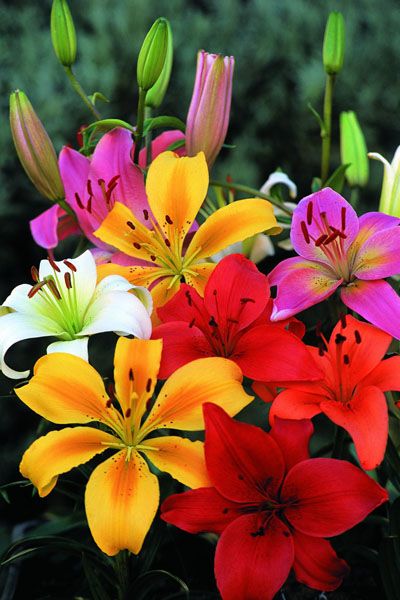
Lilies are often called the queens of the summer garden. From the wealth of lily varieties it is easy to choose ones that will delight us with beautiful flowers every year. Lilies are suitable for borders, for groups on lawns and for planting by water, and they are also among the most popular cut flowers.
Lilies are bulbous plants of the lily family (Liliaceae). About 100 species are known. Despite such variety, most species share several features: a bulb made of numerous scales, and a flower of 6 petals (tepals) set in two whorls, with six stamens with large anthers and one larger pistil in the centre.
Lilies are divided into the following groups: Asiatic hybrids, Martagon hybrids, Candidum hybrids, American hybrids, Longiflorum hybrids, trumpet hybrids, oriental hybrids, hybrids not assigned to the above groups, and botanical species. Breeding keeps producing new hybrids, strains and varieties. Several thousand hybrid varieties are already known, and new ones appear every year.
Recently it has also become possible to grow inter-group hybrids, e.g. Asiatic × oriental (rich in colours and easy to grow) and Longiflorum × oriental (multicoloured, large, elongated flowers). The breeders' latest success is crossing oriental and trumpet lilies – the so-called Orienpets. They are easy to grow and have large flowers, many per stem.
Of these groups, Asiatic, trumpet and oriental hybrids are the most important.
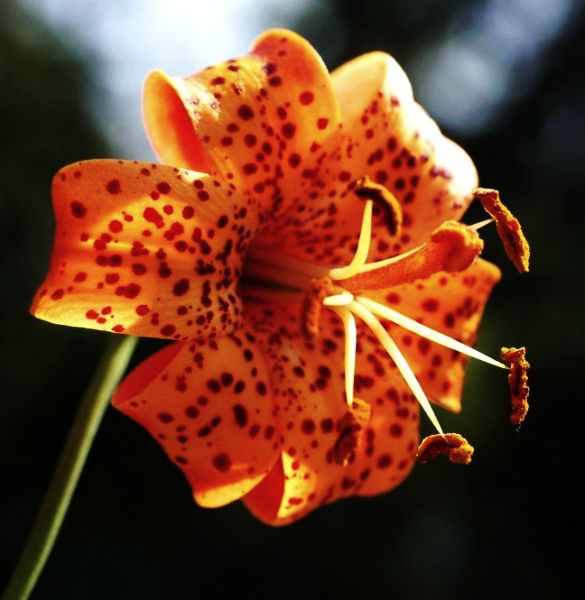
Asiatic hybrids include undemanding varieties that flower from the end of May to mid-July. Most of them withstand Polish winters very well and are highly disease-resistant. This group includes the tiger lily, Lilium tigrinum, popular in Polish gardens, which grows to 120–150 cm and has spotted orange flowers in clusters. Well-known varieties in this group include 'Enchantment' (orange-red), 'Connecticut King' (lemon-yellow), 'Cyganka' (red) and 'Mont Blanc' (creamy white).
Optimal conditions for this group are fertile, free-draining, slightly acidic and moderately moist soil. Choose the spot carefully, as lilies do not like being moved and flower best when left in the same place for several years. The bed should be in full sun for at least several hours a day.
Trumpet hybrids have showy, strongly scented flowers. They flower from the end of July, but usually only in the second year after planting. Frequent moving is not good for them either. This group includes a famous beauty – the regal lily, Lilium regale, with fragrant flowers, which can reach 2 m. Trumpet lilies grow best in neutral or slightly alkaline soil in sun or partial shade. For winter it is good to cover the planted bulbs lightly with leaves, bark or straw, and the young shoots must also be protected from spring frosts.
Oriental hybrids are the most beautiful lilies, but also the most demanding. Typical colours for this group are pink and white in varying intensity. Well-known varieties include 'Casa Blanca' (white) and 'Jamboree' (purple-red). Oriental lilies can survive the winter only under a solid covering. It is best, however, to lift the bulbs for the winter and store them in a room at 2°C. They can also be planted in large containers and overwintered in a cool cellar. Oriental lilies are also sensitive to cold and rain in summer. They flower at the end of July and in August. They need acidic, peaty soil and flower best in light shade.
Requirements
Although most lily varieties survive our winters, covering them is recommended, as it prevents temperature fluctuations and also protects against late spring frosts.
Propagation
Lilies are propagated both from seed and from offset bulbs, which form beside the mother bulbs, in the leaf axils (bulbils), on the flower stems, at the base of bulb scales used as cuttings, and at the base of cuttings made from leaves cut off with a piece of stem – a method used only for narrow-leaved lilies.
Care
Lilies do well in our climate and tolerate our winters, except for those from near the equator, especially orientals, which must be lifted for the winter. Remember that lily bulbs need a period of cold to flower properly. The position should be sunny, with deeply cultivated, humus-rich, slightly acidic soil.
They like fairly moist soil and air, so they do well near water. It is good if they are sheltered on the north side by shrubs, which protect them from cold wind. Lift lily bulbs every 2–3 years. It is important to keep to the right planting times. Most lilies that overwinter in the ground are planted from the end of September to early October; Madonna lily (Lilium candidum) bulbs are planted earliest, at the end of August. Plant 20 x 20 cm apart, at a depth three times the height of the bulb, i.e. about 10–15 cm. Plant the Madonna lily so that the soil covering it is no more than 5 cm thick. Lift frost-sensitive bulbs in October and store them over winter covered with peat at 2–3°C; replant them in late March or April. Lilies need moderate feeding and generous watering, but also good drainage so that the soil is suitably dry during the rest period. During the growing season it is good to mulch lilies, e.g. with peat, to keep the soil constantly moist.
When plants get sick
Before planting, the bulbs must be treated with a disinfectant (fungicide). This is very important, because lilies can be affected by many diseases, e.g. mosaic virus, leaf spot, twisting of shoots and leaves, grey mould (botrytis) and bulb rot. The most common pests are aphids, thrips, the lily leaf beetle, nematodes and voles, which do the most damage by eating the bulbs.