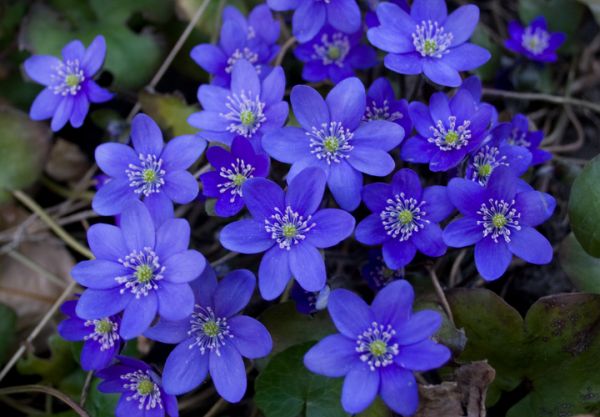
Description
Hepatica (liverleaf) is a perennial of the buttercup family. It occurs in almost all of Europe and in the Far East. In Poland it is rarer or absent only locally; otherwise it is a fairly widespread species of fertile deciduous woods. In many countries it is grown as an ornamental plant, and in the past it was also used medicinally. To protect wild populations from being destroyed by flower picking and digging up of plants, hepatica is strictly protected in Poland.
The whole plant reaches 15–20 cm in height.
Just below the soil the stem forms a short, cylindrical, dark brown, very fibrous rhizome covered with scales at the top. From the axils of the scales grow the leaves and hairy, red or brown flower stalks, each ending in a single flower.
The leaves are partly evergreen, leathery and long-stalked, forming a basal rosette. At first they are white-hairy or woolly, becoming smooth with time. Young leaves are light green, becoming dark green on top with age and more or less red-violet underneath. The leaf blade is three-lobed, entire and heart-shaped at the base.
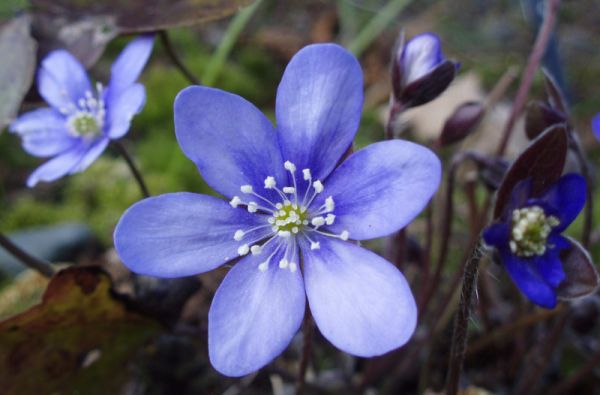
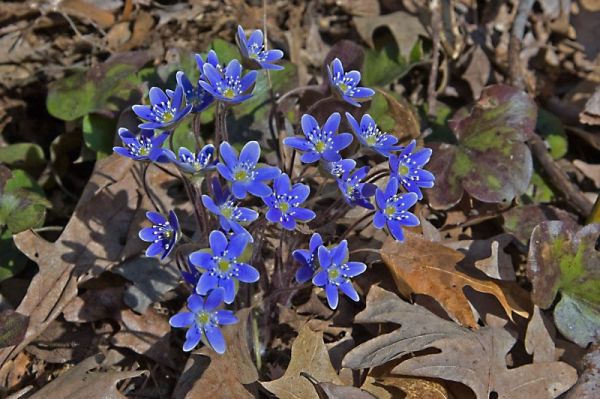
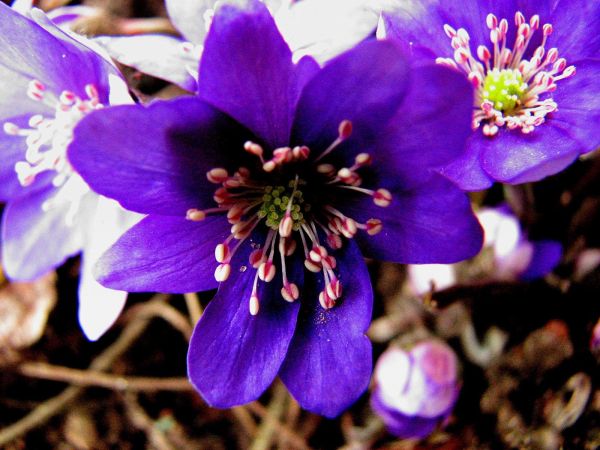
Blue-violet flowers 15–30 mm across appear in early spring, before the leaves unfold, on stalks 10 cm tall. Sometimes they are pink, more rarely white. Each flower is supported by three small, egg-shaped, blunt, stalkless bracts fused at the base, forming a false calyx. These bracts do not drop, even while the fruits ripen. The perianth usually consists of 5–6 coloured segments. The flower has many spirally arranged pistils and stamens with white or pink filaments. The pistils are downy, topped with short, straight styles.
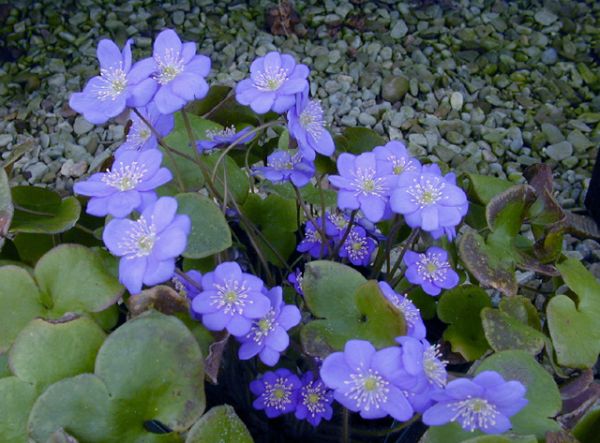
Hepatica is grown as an ornamental plant, valued for its striking flowers, early flowering, decorative foliage, high shade tolerance and resistance to other unfavourable conditions, and for its longevity. In Poland it is still rarely offered by nurseries because it is difficult to propagate. It is used in rock gardens or woodland-style park plantings, preferably in groups. It forms attractive combinations with other spring-flowering plants – bulbs, as well as spring adonis, anemones and sweet violets.
Requirements
Hepatica grows in woods and thickets, preferably on chalky or neutral ground. It needs loamy, humus-rich soils; on lighter soils the plants grow less well, are paler (yellowish-green) and flower less. Hepatica prefers shady and partially shaded positions, fresh to dry.
Propagation
The plants spread with the help of ants, which carry away the fruits, and to a lesser extent by their branching, spreading rhizomes. The older the plants, the larger the clumps they form and the more profusely they flower – old clumps can produce more than 20 flowers.
It is usually propagated by division, as it sets seed poorly, and double-flowered varieties raised from seed do not retain the parents' traits. Sow the seeds as soon as they ripen into moist soil in a sheltered place. If they are stored, they need stratification – keep them at 0–5°C for 3 weeks. Germination takes from 1 to 12 months. After pricking out, let the seedlings develop for their first year in a greenhouse, keeping them shaded and constantly moist. Plant them in their final position at the end of spring or beginning of summer. Mature plants – ideally the largest possible clumps – are best divided just before flowering, at the end of winter, or immediately after flowering. Plant the divisions straight into their final position.
Care
Hepaticas like to be left in peace; they tolerate root damage very badly, and after division they grow very slowly. For this reason, move them only as a last resort.
The plant is poisonous if eaten in larger quantities. Poisoning is very rare because of its burning taste. If eaten, it causes inflammation of the mucous membranes of the mouth, stomach and intestines, bloody diarrhoea, fainting, sometimes convulsions, and finally circulatory and respiratory failure and kidney inflammation. Poisoning can cause irreversible kidney damage. If the plant has been eaten, gastric lavage is needed; do not induce vomiting, but give plenty of fluids – and seek medical help.