Description
Many houseplants come to life just when others are entering their winter rest. Here I explain how to look after plants that flower in winter.
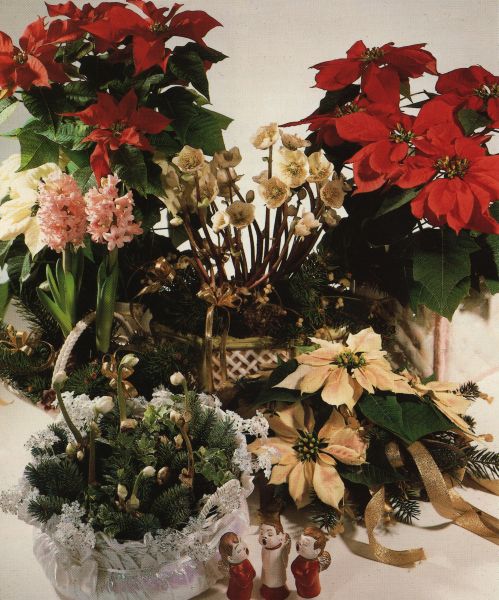
Standing in front of a florist's window in November or December, you can see that despite the winter there are many different flowering plants on display. Next to typical Christmas plants such as poinsettias or Christmas cacti, florists also offer many varieties of cyclamen, winter begonias and azaleas.
Be careful when buying, though, and do not buy such sensitive plants on frosty days. They can freeze on the way home. Even on a mild November day the plant should be well wrapped, ideally in paper or foil and then additionally in newspaper.
All plants sold in winter usually come from large greenhouses and are used to the climate there. When such a plant is moved straight into a centrally heated room where the air is quite dry, it may take it very badly – even if dry air would not normally harm it much. So, if possible, it is worth finding or arranging a slightly cooler transitional room. What matters is that the air there is not as dry as in the rest of the home, so that the plants can gradually get used to the new conditions. Many winter-flowering plants, such as camellias or anthuriums, have problems precisely in centrally heated rooms.
They often have another specific problem too. When they are misted with a sprayer, the flowers often become spotted and then drop. It is better to make up for the lack of humidity by standing the pot in a tray filled with water and pebbles.
Watch out for windows
Even in a well-heated room, plants standing on windowsills can get cold – especially where frost appears on the windows in the morning. When plants stand so that their shoots touch the frozen glass, they can suffer a thermal shock and, worst of all, never recover from it.
At the same time, most winter-flowering plants like moderate temperatures of about 15°C. This is often a problem for houseplant lovers, who do not want to be cold just because their flowers like such low temperatures. On the other hand, the whole point of buying winter-flowering plants is to enjoy them indoors.
The only solution is a compromise: turn the heating down at night.
Light is essential
Winter is not called the dark season for nothing. In late autumn the light in our homes quickly fades. For plants that are expected not only to grow but also to flower at this time of year, this is a serious problem. In winter, plants are especially drawn towards the windows. Their owners, however, often make the mistake of forgetting this or, to protect the plants from the heat of the radiators, putting them in a dark corner. In this situation artificial lighting that supplements – and often replaces – daylight can be an effective solution. The plants will then develop properly indoors.
Be careful when moving them
Winter-flowering plants are sensitive and need special treatment. Once they start forming buds, you must not change the angle at which light falls on them. Otherwise the buds will quickly drop and the plant will not flower properly. It is worth sticking a marker on the pot. And before buying, it is good to think about the conditions the plant will need.
Proper watering
Plants that flower in winter need a little more feeding than those that are resting at this time. When watering, a few rules should be followed. Above all, never use ice-cold water straight from the tap – it could kill the plant. It is best to fill the watering can the evening before. This lets the chlorine in the water evaporate and the calcium particles settle at the bottom.
At the same time, make sure the roots do not stand in water. A few minutes after watering, pour away the water from the saucer. And do not forget to add the right dose of liquid fertiliser to the water.