Description
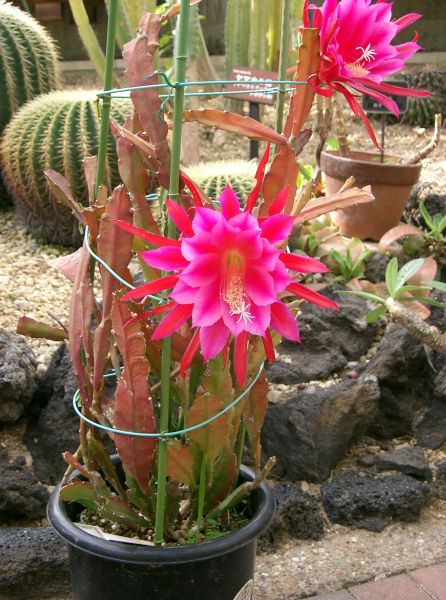
Epiphyllum has long, leaf-like stems on whose edges the flowers form. It differs fundamentally from desert cacti: it needs more shade, fertile and porous soil and higher air humidity.
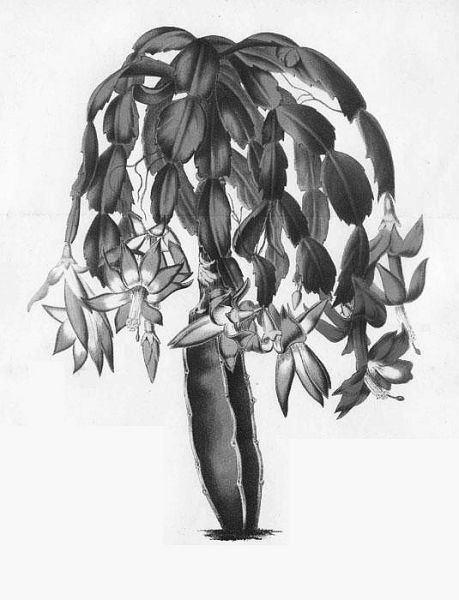
Almost all the beautiful leaf cacti are hybrids of various species. All have very decorative flowers up to 20 cm long, and new varieties keep appearing. In the past, leaf cacti had a very weak root system and were therefore grafted onto Queen of the Night (Selenicereus), which by contrast has a very well-developed root system. This is how profusely flowering "cactus trees" were bred.
Epiphyllum is one of the plants that in tropical countries live on other plants, trees and shrubs. They are not parasites, however, as they do not use the nutrients of the trees on which they settle. They feed on decaying plant debris and use both rainwater and moisture from the soil.
Epiphyllum hybrids can be very large. Older specimens have long, hanging, leaf-like stems and look very decorative on a tall plant stand or in a hanging pot.
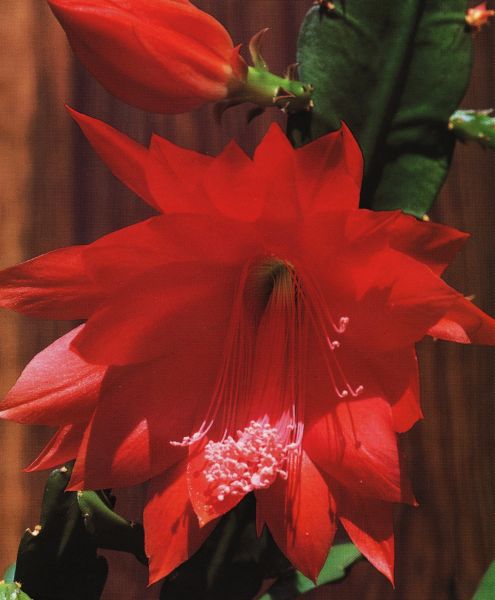
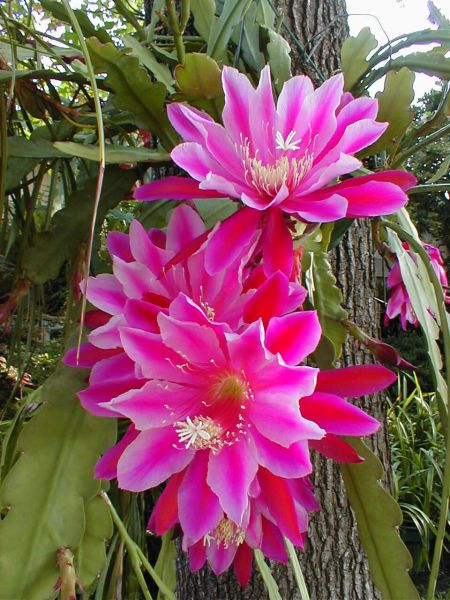
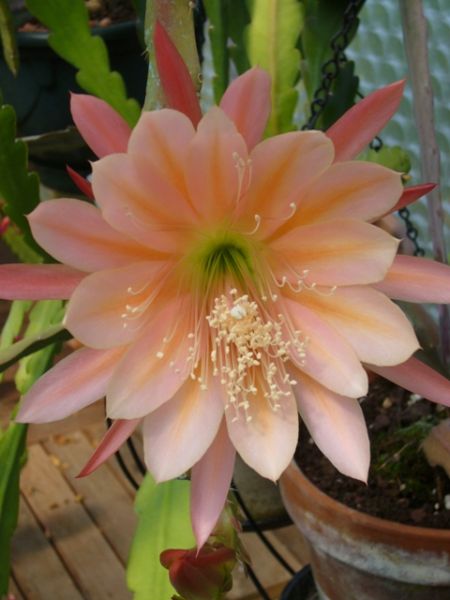
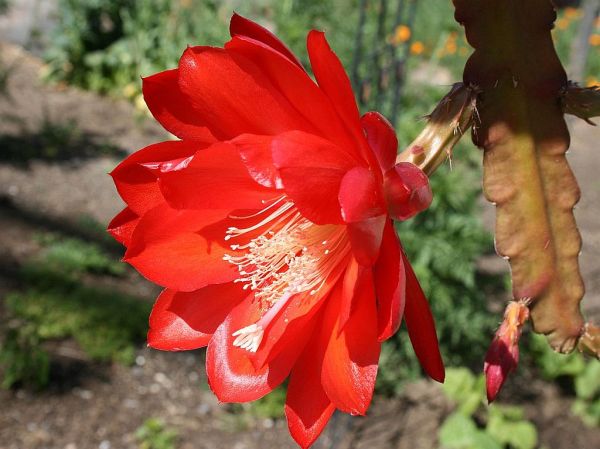
Epiphyllum flowers from May to July. Some varieties have flowers as large as twenty centimetres, in colours ranging from white-yellow and orange to pink, red and violet. Each flower lasts only a very short time.
Requirements
The secret of abundant flowering lies in observing complete rest periods and the right temperature. In spring and summer the plants tolerate plenty of warmth; during the winter rest the temperature should, if possible, be constant at 8–10°C. Only then will it reward you again with abundant flowers the following spring. If you put the plant outside in summer, remember that it prefers a shady, sheltered spot.
February – May
From February the plant starts growing again and should be moved to a brighter place. Start watering regularly but carefully. As soon as the first buds appear, increase the amount of water. From now on the plant must not be moved.
July – August
The cactus has finished flowering and needs peace. Partial shade is a suitable place. In mid-August you can repot the plant and water more again, feeding once a week. If the flowering was poor, use a fertiliser containing phosphorus.
September – January
Gradually reduce the amount of water. From November the plant should be kept cool. Water only enough to stop the stems shrivelling.
Propagation
To propagate the plant, cut off a healthy stem and use a 5–10 cm piece as a cutting. Before planting the cutting in a mix of soil and sand, let the cut surface dry for a day. Roots form after 2–3 weeks. Several cuttings can be put in one pot. Cover it with a plastic bag to create a greenhouse effect. A young cactus flowers only after 2–3 years.
Care
Water Epiphyllum with lukewarm, soft, lime-free water. For a while after flowering, feed roughly twice a week.
Epiphyllum needs a mix of 1/4 sharp sand and 3/4 humus-rich soil. Repot in August, some time before feeding. After flowering, cut off old, damaged and unsightly stems.
The plant does very well in a conservatory or a slightly cooler room.
When plants get sick
The buds drop – the plant must have been moved during flowering. Leave it in peace. Another cause may be lack of water while the plant was preparing to flower.
Rotting stem bases – the plant stood in the cold and had too much water.
Before you buy
Buy an Epiphyllum that is in flower, as the buds drop easily when it is moved and the plant will not flower again. The stems should be green and glossy.
Average lifespan: it lives to a ripe old age.
Difficulty of care: easy to grow if you meet its requirements.